A clear account of The Iran–Iraq War, its military choices, human cost, and lasting regional legacy for U.S. and global policy
Origins and political context
The Iran–Iraq War erupted amid a mix of territorial disputes, ideological rivalry, and regional power plays. As one source notes, “The Iran–Iraq War, fought between 1980 and 1988, stands as one of the most protracted and devastating conflicts of the late twentieth century.” That sentence captures why the war matters for modern geopolitics, and why policymakers and historians still study its causes and consequences.
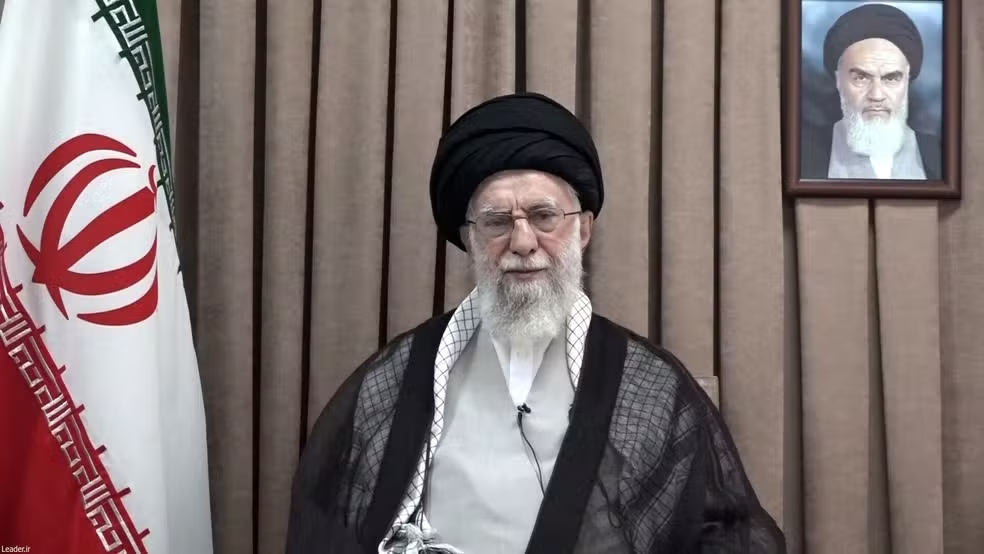
On September 22, 1980, a decisive moment arrived. “The war began with an Iraqi invasion of Iran on September 22, 1980.” Saddam Hussein sought control of the Shatt al-Arab waterway, and he hoped to blunt the influence of Iran’s 1979 Islamic Revolution. Iran, led by Ayatollah Khomeini, viewed the confrontation as both territorial defense and an ideological struggle, as Tehran feared encirclement and the spread of revolutionary politics in the region.
International players, including the United States, the Soviet Union, and European powers, declared official neutrality, but practical support tended to favor Baghdad. Gulf Arab states, notably Saudi Arabia and Kuwait, provided financing and logistical backing to Iraq, seeing Iran’s revolution as a cluster of threats to monarchies and regional stability. This external tilt complicated the war, making it not only a bilateral fight, but a proxy arena for wider Cold War and regional concerns.
Military strategy, stalemate, and chemical weapons
Both Iran and Iraq entered the conflict with different strengths and misjudgments. Iraq relied on conventional advantages, including tanks, aircraft, and foreign-supplied weaponry, expecting a quick victory. Iran, weakened by post-revolutionary purges in its military, mobilized irregular forces and embraced human-wave assaults and asymmetric tactics to offset Iraqi technical superiority.
The fighting quickly hardened into a grinding stalemate. Trench lines, fortified positions, and repeated offensives produced heavy casualties for limited territorial change. Military analysts point to an overreliance on attrition by both sides, a costly approach that prolonged the war and made decisive victory impossible.
One of the darkest chapters in the conflict was Iraq’s employment of chemical weapons. According to the sources, “Beginning in 1983, the Iraqi regime deployed mustard gas, sarin, and other agents against Iranian forces, as well as against Kurdish populations in northern Iraq.” The attacks inflicted immediate mass casualties, and they left long-term health consequences for survivors, soldiers, and civilians. The chemical strikes at Halabja and elsewhere exposed a gap between international law and political will, as global condemnation often did not translate into strong punitive measures against Baghdad.
The war also moved beyond ground combat. The so called Tanker War saw both sides targeting neutral and commercial shipping in the Persian Gulf, aiming to choke the other’s oil revenues and apply economic pressure. The U.S. response, including naval escorts under Operation Earnest Will, highlighted how a regional conflict could threaten global energy supplies and compel direct intervention by outside powers.
The human cost and societal impact
The human toll of The Iran–Iraq War was staggering. As the record states, “Estimates suggest that the Iran–Iraq War caused between 500,000 and 1,000,000 casualties, including military and civilian deaths, with millions more wounded or displaced.” Those numbers reflect deaths, injuries, and a generation of people whose lives were rearranged by violence and dislocation.
On the Iranian side, the war generated a powerful narrative of resistance, sometimes called the “Sacred Defense,” which fused national survival and religious devotion. Iran relied heavily on volunteer militias, young fighters, and broad civilian mobilization to sustain its defenses and counteroffensives. That mobilization produced deep social strains, including disrupted education, psychological trauma, and long term health problems related to chemical exposure.
In Iraq, the conflict consolidated Saddam Hussein’s domestic control, yet it drained the economy and left towns near the frontier devastated. Kurdish civilians bore particularly horrendous consequences from chemical attacks and state repression. Across both societies, women took on expanded economic and caregiving roles, while families coped with loss and displacement. The war’s damage to infrastructure, agriculture, and oil facilities slowed postwar recovery for years.
Ceasefire, aftermath, and strategic lessons
After eight years of devastating combat, the war ended in 1988. The international community called for an end to the fighting, and the conflict concluded with the adoption of “United Nations Security Council Resolution 598, calling for a ceasefire and return to prewar borders.” The resolution halted active large scale combat in 1988, yet it left many issues unresolved, including political grievances and the long shadow of chemical weapon use.
The aftermath transformed regional dynamics. Iraq emerged militarily battered and economically strained, a condition that helped set the stage for later confrontations in the Gulf. Iran, though territorially intact, was left with a legacy of wartime sacrifice, a fortified military ethos, and an inward focused security posture. Both countries carried long term medical and social burdens from the conflict.
From a strategic perspective, the Iran–Iraq War offers several clear lessons. Prolonged attrition warfare can produce catastrophic human costs with little lasting political gain. The use of chemical and unconventional weapons may deliver short term tactical results, but they create enduring legal, moral, and reputational damage. The war also underlined the influence of external powers and regional patrons on local conflicts, as diplomatic ambiguity and material support helped sustain the fighting.
For policymakers, these lessons remain relevant. The Iran–Iraq War shows how local disputes, when combined with ideology, external backing, and strategic miscalculation, can spiral into long, costly wars. The conflict also demonstrates that reconstruction and reconciliation after such wars require decades of sustained investment, medical care, and political will.
Memory, culture, and why it still matters
Beyond strategy and statistics, the lived experiences of veterans, refugees, and survivors shape how the Iran–Iraq War is remembered. In Iran, state and community commemorations emphasize sacrifice and resilience, while in Iraq, official narratives under Saddam highlighted heroism, even as civilian suffering was widespread. Oral histories, literature, and public memory preserve the human dimension, keeping the war present in both societies.
Today, the conflict’s consequences are visible in regional politics, military doctrine, and international law debates. The war remains a reference point for discussions about chemical weapons, regional security, and the risks of prolonged conventional conflicts. Understanding the war in full, from its strategic choices to its human toll, helps explain key features of the modern Middle East, and it provides cautionary guidance for leaders facing the prospect of violent confrontation.
The Iran–Iraq War is more than an historical episode, it is a living lesson in the costs of unresolved rivalry, the dangers of prohibited weapons, and the complexity of regional security. Its memory continues to shape policies and societies across the Middle East, and it remains essential reading for anyone who studies war, diplomacy, and reconstruction in our time.