A clear, narrative look at THE CRUSADES, from Pope Urban II’s 1095 speech to the 1291 loss of Acre, and why these wars still shape global memory
The Crusades were not a single campaign, a single motive, or a single people. As one source puts it, “The Crusades stand among the most transformative, controversial, and symbolically charged events of the Middle Ages.” That sentence, repeated across scholarship, captures why the period from 1095 to 1291 continues to fascinate and trouble readers today.

The world that produced the crusades
At the end of the 11th century, Europe was changing fast. Population growth and new knightly elites combined with the papacy’s reform movement to create both opportunity and tension. In the east, the Islamic world was politically fragmented, with Fatimids, Seljuk Turks, and local rulers contesting power. The Seljuk victory at Manzikert in 1071 weakened Byzantium and led Emperor Alexios I to ask the West for help. Those shifts created the geopolitical opening that turned appeals for aid into a broader religiously framed war.
Pope Urban II and the birth of a holy war
Pope Urban II’s speech at the Council of Clermont on November 27, 1095, is commonly cited as the formal start of the movement known as the THE CRUSADES. Urban did more than call for armed support for Byzantium. He presented participation as a form of penance, offering spiritual remission to warriors who took up the cross. Men and women across Europe answered, becoming crucesignati, “those signed with the cross.” The response combined religious devotion, social mobility, and the search for salvation, all of which fueled a mass movement that crossed social classes and borders.
The First Crusade, conquest, and contradiction
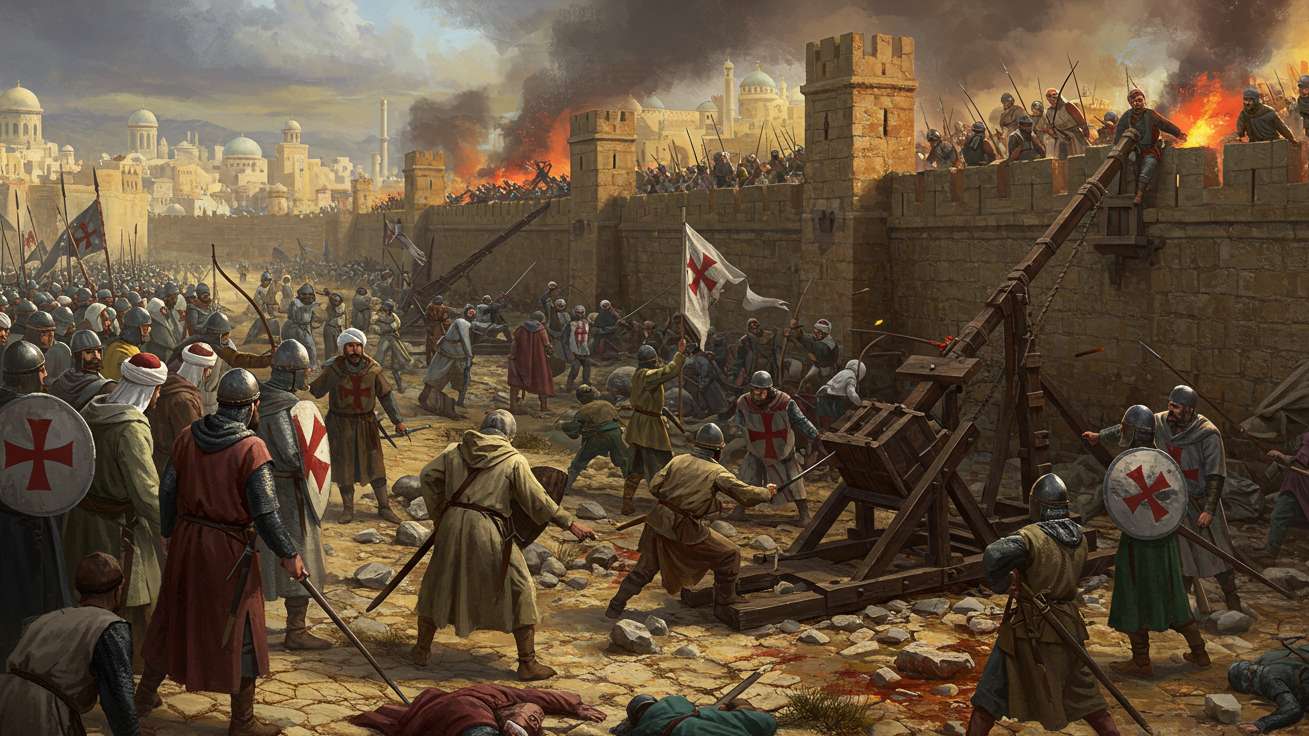
The First Crusade, roughly 1096 to 1099, produced the most dramatic early results, including the capture of Jerusalem. Contemporary chronicles describe the aftermath with brutal language, reporting the streets ‘running with blood’, an image that still shapes Muslim memory and modern debate. The result of these campaigns was the creation of fragile Latin states, like the Kingdom of Jerusalem, that forced daily contact between Christians, Muslims, and Jews. Those contacts mixed violence and cooperation, and they complicate simple, heroic narratives of the crusades.
Scholars note that military success was not only a matter of religious zeal. Political fragmentation among Muslim rulers, strategic alliances, and sheer chance played decisive roles. In short, the early crusader victories were as much products of opportunity as of conviction.

From Edessa to Saladin: resilience, jihad, and renewal
The fall of Edessa in 1144 to Zengi changed the conversation in Europe. Calls for a new expedition produced the Second Crusade, led by kings, which ended in disappointment. At the same time, Muslim leaders like Zengi, Nur ad-Din, and later Saladin, promoted a more unified response often described as jihad, strengthening both political and religious resistance. Saladin’s victory at Hattin in 1187 and the recapture of Jerusalem shifted momentum and produced a high-profile European response in the Third Crusade. Even when leaders like Richard the Lionheart scored battlefield victories, the political outcomes remained ambiguous, and Jerusalem stayed out of Christian hands.
Throughout these decades, the interplay of military skill, theological framing, diplomacy, and reputation-building shaped outcomes. Saladin, for example, built a reputation for justice and mercy that resonated across the Islamic world, while crusader leaders balanced piety and pragmatism in a volatile theater of war.
Later crusades, fragmentation, and the end in 1291
The later crusades underscore how political divisions and shifting priorities wore down sustained European efforts. The Fourth Crusade’s diversion to Constantinople in 1204 fractured Christian unity, with consequences that lasted centuries. Subsequent campaigns mixed military attempts with diplomacy, while the Seventh and Eighth Crusades ended largely in failure. By 1291, when Acre fell to the Mamluks, the Latin states on the Levantine coast had vanished. Yet disappearance from the map did not erase the memory or the deep changes these encounters produced.
Across scholarship, commentators return to a clear claim: “Across the 15 reliable publications, one truth stands firm: the Crusades were not a single event, a single war, or a single ideology.” That conclusion pushes historians to emphasize nuance, local experience, and the mixed legacies of violence and exchange.
Everyday life, exchange, and the long shadow
One of the most revealing findings in modern studies of the crusader period is how often violence and coexistence were intertwined. The crusader states became sites of commerce, intermarriage, architectural hybridization, and diplomatic negotiation. Archaeology and art history show buildings and objects that blend Western, Byzantine, and Islamic forms. These everyday interactions did not erase conflict, but they complicate any story that reduces the period to pure confrontation.
The Crusades also spurred wider transformations. Europe gained access to new knowledge, medicines, and trade networks, while the Islamic world refined political responses and theological discussions about defense and leadership. The Byzantine Empire suffered enormously, especially after 1204, and Mediterranean trade networks shifted, reshaping economic ties between East and West.
Memory, myth, and modern uses
The long cultural life of the crusader narrative makes the medieval events politically potent in the modern period. In Europe and North America, the crusades have been romanticized and weaponized. In the Middle East, crusader imagery is sometimes used to frame modern grievances. Extremist groups on all sides have misappropriated crusader language and symbols. Historians caution that the best defense against distortion is careful, evidence-driven work that emphasizes the period’s complexity.
As one closing reflection asks, and as scholars often remind readers, “When people believe they are fighting for God, what are they capable of?” The answers are mixed, and they reflect the contradictions at the heart of the crusades: devotion and brutality, exchange and estrangement, collapse and renewal.
Understanding THE CRUSADES means grappling with these tensions. It means recognizing the local, practical decisions that shaped everyday life in the Levant, and also acknowledging how high ideas, like penance, jihad, authority, and salvation, animated leaders and foot soldiers alike. The period from 1095 to 1291 is not a single story. It is a long encounter that reshaped politics, economies, religions, and memories on both sides of the Mediterranean, and those consequences still echo today.