A Tragic Convergence of Strategy, Ideology, and Human Cost
The Vietnam War remains one of the most controversial and complex conflicts of the twentieth century, a war whose reverberations continue to shape military strategy, political discourse, and cultural memory. From the lush rice paddies of the Mekong Delta to the urban ruins of Hue, the Vietnam War was a theater in which ideology, geopolitics, and human experience collided with devastating consequences. Scholars, journalists, and veterans have chronicled the war from multiple perspectives, creating a rich tapestry of literature that examines not only military operations but also the societal, political, and moral ramifications of the conflict. Drawing upon seminal works such as A Bright Shining Lie by Neil Sheehan, Vietnam: An Epic Tragedy by Max Hastings, and The Sorrow of War by Bảo Ninh, we can gain a nuanced understanding of this pivotal episode in modern history.
Historical Context and the Road to War
The roots of the Vietnam War extend back to the colonial era, where French imperial ambitions and Vietnamese resistance set the stage for decades of conflict. Following the Japanese occupation during World War II, Vietnam faced a power vacuum that intensified nationalist aspirations. Works like Embers of War by Fredrik Logevall illuminate how the dissolution of the French colonial empire intertwined with the emerging Cold War dynamics, drawing the United States into a conflict framed as a necessary bulwark against communist expansion. The Truman and Eisenhower administrations, convinced of the “domino theory,” gradually increased support for the French-backed regime in Saigon, setting the stage for deeper American involvement.
By the early 1960s, the conflict had escalated from advisory missions and financial support into active military engagement. The Gulf of Tonkin incident in 1964 provided the pretext for the U.S. Congress to grant President Lyndon Johnson expansive military authority, leading to the rapid deployment of combat troops. Hastings’ Vietnam: An Epic Tragedy emphasizes that while strategic objectives were often poorly defined, the war’s escalation reflected a broader misreading of Vietnam’s political and cultural landscape. The U.S. approach relied heavily on technological superiority, conventional tactics, and firepower, often ignoring the complex social, geographical, and ideological factors that determined local allegiances and resistance.
Military Strategy and the Challenges of Guerrilla Warfare
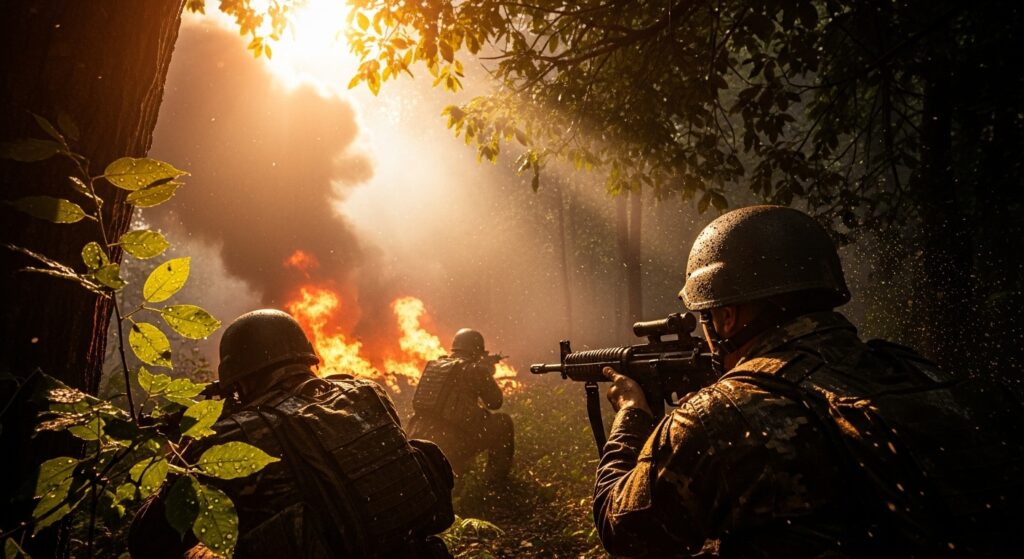
The Vietnam War was unique in the challenges it presented to conventional military thinking. The North Vietnamese Army (NVA) and the Viet Cong relied on guerrilla tactics, exploiting dense jungles, intricate tunnel systems, and intimate knowledge of the terrain. The American military, despite its overwhelming firepower and superior logistics, struggled to counter an enemy that could vanish into the environment and reemerge unpredictably. In Vietnam at War: The History, 1946–1975, Shaun M. Young details how the asymmetric nature of the conflict forced the U.S. to adapt continuously, yet often ineffectively, as conventional strategies were ill-suited to counterinsurgency.
Helicopter mobility, exemplified in the air cavalry concept, allowed rapid troop deployment, but it could not entirely mitigate the limitations imposed by unfamiliar terrain and an elusive enemy. The Tet Offensive of 1968, chronicled in Hue 1968, underscored the strategic paradox: although militarily costly for the Viet Cong, the offensive exposed vulnerabilities in U.S. planning and shattered public perception of progress. Here, tactical victories could translate into strategic defeats, highlighting the intricate interplay between military operations, media portrayal, and domestic politics.
The Human Dimension: Soldiers, Civilians, and Psychological Trauma
Beyond strategy and tactics, the Vietnam War is remembered for its profound human cost. Philip Caputo’s A Rumor of War provides an intimate account from the perspective of a U.S. Marine officer, detailing not only battlefield encounters but also the moral ambiguities faced by soldiers in a conflict where front lines were fluid and distinctions between combatants and civilians often blurred. Similarly, Bảo Ninh’s The Sorrow of War offers the Vietnamese perspective, emphasizing the psychological scars borne by combatants and the devastation endured by local populations. These works collectively illustrate that the human experience of war transcends ideology, leaving a legacy of trauma, grief, and ethical reflection.
Nick Turse’s Kill Anything That Moves further examines the darker aspects of the conflict, documenting the systematic violence inflicted upon civilians and challenging narratives that downplay atrocities. This scholarship reinforces a crucial insight: wars are not solely defined by strategies and outcomes, but also by the lived experiences of those caught within their machinery.
Media, Perception, and the Politics of Memory
One of the defining features of the Vietnam War was the pervasive influence of media. For the first time in history, television brought combat directly into American living rooms, shaping public opinion and exerting unprecedented pressure on policymakers. Hastings and Sheehan both argue that media coverage transformed the war into a narrative battlefield, where perceptions of legitimacy, morality, and progress were contested as fiercely as any territory.
Jerry Lembcke’s The Spitting Image analyzes postwar myths, such as the notion that antiwar demonstrators routinely spat upon returning soldiers. Lembcke demonstrates how memory and myth can distort public understanding, influencing policy and collective consciousness long after the conflict has ended. This interplay of media, memory, and myth underscores the war’s enduring complexity, reminding us that historical understanding is contingent upon narrative as much as fact.
Political Consequences and International Implications
The Vietnam War’s impact extended far beyond Southeast Asia. Domestically, it catalyzed social upheaval, fueling civil rights activism, antiwar protests, and generational divides. Politically, it exposed the limitations of American military power and strategic foresight, fostering skepticism towards interventionist policies. On the international stage, it shaped Cold War dynamics, compelling allies and adversaries alike to reassess their approaches to both containment and diplomacy.
Sheehan’s meticulous narrative in A Bright Shining Lie examines the life and career of John Paul Vann, whose attempts to navigate the political and military complexities of Vietnam highlight the often-conflicting demands of strategy, ethics, and bureaucratic constraint. The war, in this sense, was as much about navigating the machinery of governance and international expectations as it was about battlefield engagements.
Lessons Learned and Historical Legacy
The Vietnam War offers enduring lessons for military planners, policymakers, and scholars. The conflict demonstrated that superior technology and firepower do not guarantee victory against an adaptive and motivated adversary. Terrain, culture, and local support can decisively influence outcomes, rendering conventional metrics of strength insufficient. The U.S. experience in Vietnam has since informed doctrines of counterinsurgency, asymmetric warfare, and the importance of political legitimacy in military operations.
Furthermore, the war underscores the moral and ethical dimensions of conflict. Civilian protection, the psychological well-being of soldiers, and the maintenance of legitimacy are integral to both operational success and historical judgment. Vietnam reminds us that wars are not merely contests of force, they are complex social phenomena shaped by human choices, limitations, and consequences.
Conclusion: Vietnam as a Mirror of Modern Conflict
In retrospect, the Vietnam War stands as a tragic yet instructive chapter in modern history. It exemplifies the convergence of ideology, strategy, and human cost, offering insights that extend well beyond its temporal and geographical boundaries. The literature, from Hastings’ sweeping narratives to Caputo’s personal memoirs, from Turse’s forensic research to Ninh’s poetic introspection, collectively illuminates the war’s multifaceted character.
Ultimately, Vietnam is a mirror, reflecting the perils of misjudged strategy, the consequences of underestimating human resilience, and the enduring moral questions that arise whenever nations confront one another in war. Its lessons resonate in contemporary conflicts, reminding policymakers, military leaders, and societies alike that the calculus of warfare is never purely mathematical, it is profoundly human, in all its tragedy and complexity.
The war may have ended decades ago, but its reverberations continue to echo, compelling each generation to grapple with the consequences of power, ideology, and the unyielding realities of human conflict. To understand the Vietnam War is to confront not only the past but also the ethical and strategic dilemmas that define the conduct of war in our own era.