Why The Avoidable Wa matters, what Kevin Rudd’s ten concentric circles reveal about Xi Jinping, and how ‘managed strategic competition’ could keep the world from sliding into war
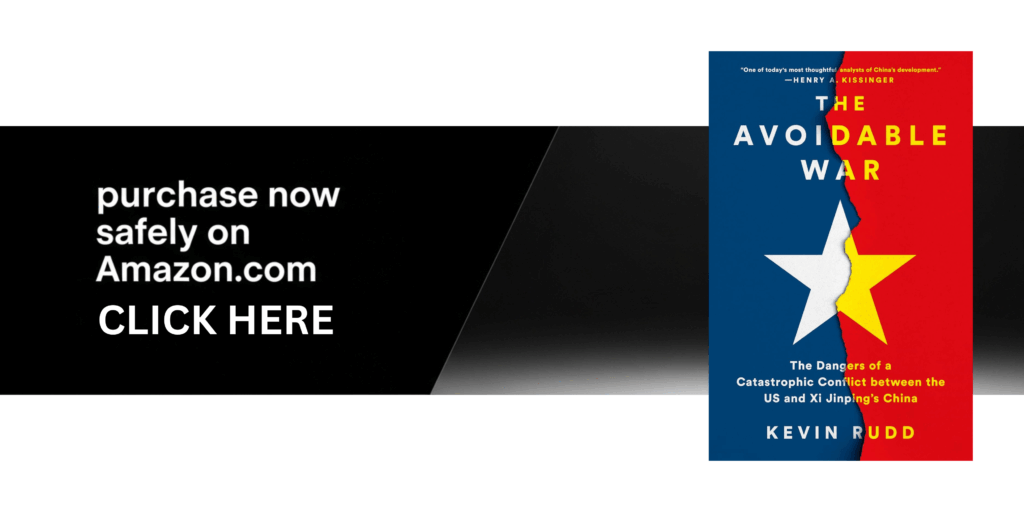
The Avoidable Wa by Kevin Rudd arrives as a clear, urgent manual for avoiding the most terrifying possibility of this century, a major war between the United States and China. Rudd, a Mandarin-speaking former Australian prime minister who met Xi Jinping, writes not as a distant analyst, but as a practitioner who has stood inside the rooms where decisions are made. Across reviews in the Financial Times, Kirkus, the National Bureau of Asian Research, SAGE Journals, the Naval War College, and other outlets, critics agree on one point, Rudd brings rare authority.
A world balanced on a knife-edge
Rudd’s central warning is simple, and stark. The U.S.-China relationship has deteriorated so sharply that the old status quo no longer guarantees stability, it only prolongs suspense. From trade wars to naval maneuvers in the South China Sea, from Taiwan to cyber conflict, both powers are edging closer to each other’s red lines. The Kirkus Review calls Rudd’s book “an accessible primer,” but many reviewers say it is more than an introduction. It is a diagnosis written by someone who has observed the problem from the inside, and it asks whether the two giants can choose to manage competition rather than drift into conflict.
Understanding Beijing, one circle at a time
One of the book’s most praised contributions is the framework Rudd uses to explain Beijing’s priorities, the ten concentric circles. Rather than reducing Chinese policy to slogans, Rudd lays out a structured hierarchy of concerns that travel from domestic survival outward to global systems. Reviewers called this lens transformative for decoding Xi Jinping’s worldview.
At the core, the 1st Circle is regime survival, above all else. Rudd shows how virtually every Chinese foreign policy move serves the Communist Party’s internal legitimacy. The 2nd Circle centers on territorial integrity, where Taiwan, Xinjiang, Tibet, and Hong Kong are presented as existential issues for Beijing. The Claremont Review highlights how Rudd frames Taiwan not as a diplomatic question, but as a “political nerve ending” of the Chinese state. Beyond those, circles expand to regional dominance in the Indo-Pacific, technological and economic leverage, and finally, ambitions to shape global norms and institutions. Reviewers note that this progression reveals a disciplined, long-term logic to China’s rise, not chaos.
The American problem, power without strategy
If Rudd depicts China as methodical, he draws the United States as powerful but inconsistent. U.S. policy bounces between engagement and confrontation. Some administrations emphasize trade, others democracy and human rights, and the machinery of American foreign policy changes with political winds. The Naval War College Review summarizes Rudd’s critique with a vivid image, the United States as “a superpower unsure whether it is in a competition, a partnership, or a slow-motion divorce with Beijing.” That uncertainty, Rudd argues, is a main driver of miscalculation and risk.
Managed strategic competition, a fragile peace plan
At the heart of Rudd’s book is his proposal for a new operating system, which he calls managed strategic competition. The idea is to accept rivalry where it exists, while imposing rules and red lines to prevent escalation into war. Key elements he proposes include agreed boundaries around certain military and cyber behaviors, an economic coexistence that accepts competition with limits, and targeted cooperation where mutual interests are clear, such as climate policy, pandemic response, and nuclear nonproliferation.
Reviewers praised this core proposal. The National Bureau of Asian Research describes the vision as “elegant and realistic at the conceptual level.” LibDemVoice calls it “the only sensible path.” SAGE Journals argues it reflects “mature diplomacy.” Yet, as many commentators warn, the plan’s elegance masks severe challenges. Critics ask who enforces the rules, and whether either side would accept limits if they believe the long-term trajectory is in their favor. The Claremont Review argues China might not accept stable coexistence if Beijing believes time favors its rise, and many analysts say trust is in short supply on both sides.
Taiwan, the fuse on a dangerous device
Few topics in Rudd’s book draw more attention than Taiwan. He treats the island as the place where miscalculation could quickly spiral into catastrophe. A cross-section of reviews highlighted Rudd’s warnings, that a war over Taiwan would ripple far beyond the region, causing economic collapse, supply chain chaos, cyber warfare, and even the real risk of nuclear escalation. He frames Taiwan as a symbol of regime legitimacy for China, a global leader in semiconductor production, a core U.S. strategic interest, and a democratic society seeking autonomy. This combination makes Taiwan the central flashpoint, and the place where Rudd insists disciplined diplomacy and clear guardrails are most urgent.
Reviewers who agree with Rudd, and those who are skeptical, converge on one point, the stakes are enormous. The Avoidable Wa forces policymakers and citizens alike to reckon with consequences that go beyond bilateral rivalry, to global economic and security systems that depend on keeping the competition managed, not molten.
Limits, doubts, and the path forward
Rudd’s enemies, critics, and cautious allies identify four main weaknesses in his argument. First, the core idea is appealing, but hard to enforce without strong mechanisms and mutual trust. Second, domestic politics in both countries can erode discipline, with U.S. election cycles and Chinese nationalist messaging pushing leaders toward confrontation. Third, some defense analysts argue he leans too heavily on diplomacy and not enough on deterrence, saying that credible military costs are needed to prevent coercion. Fourth, rapid technological change in AI, quantum communications, and hypersonic weapons often outpaces diplomatic measures, creating new sources of risk.
Still, the book’s value is widely acknowledged. Reviewers praise Rudd’s rare combination of direct access, language skill, and long-term study of China. They note he avoids demonization, critiquing both U.S. and Chinese policies, and he offers the most coherent peace proposal now on the table. When readers close The Avoidable Wa, they feel two emotions at once. There is fear, because Rudd maps how short and steep the road to conflict can be. There is also hope, because he offers a clear path, however difficult, toward preventing catastrophe.
In a world of escalating tensions, The Avoidable Wa asks whether leaders will choose to build guardrails, commit to disciplined diplomacy, and design realistic rules for competition. If Rudd is right, the difference between careful stewardship and careless drift may determine more than the fate of two great powers, it may define the safety of the global order for generations.