The legendary clash between the Greeks and the city of Troy, immortalized in Homer’s Iliad, has long been a subject of fascination, blurring the lines between myth and historical reality. Recent archaeological findings and ancient texts are now shedding new light on the possibility of a real Trojan War occurring around 1200 B.C., transforming our understanding of this pivotal event in the Late Bronze Age.
The Strategic Importance of Troy
Located at Hisarlik in modern-day Turkey, the ancient city of Troy, known to its inhabitants as Wilusa, held a crucial strategic position. Its proximity to the Dardanelles strait meant it controlled access between the Aegean Sea and the vast Anatolian interior. This made Troy not only a formidable defensive stronghold with its impressive fortified walls but also a vital hub for trade and maritime traffic. Its prominence in the geopolitical landscape of the Bronze Age made it a natural point of contention for powerful civilizations like the Mycenaean Greeks and the Hittites, suggesting that conflicts were likely inevitable, whether recorded in myth or fact.
Homer’s Epic: A Blend of Fact and Fiction
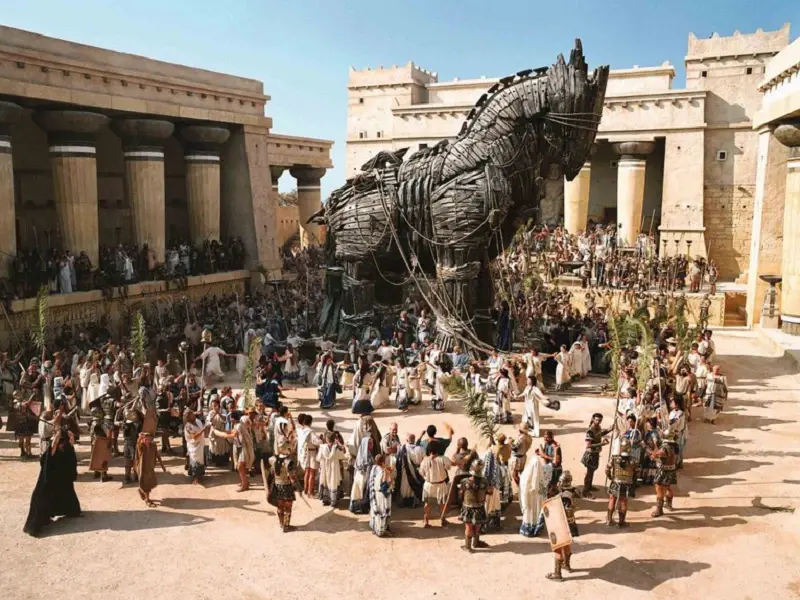
Homer’s epic poem, the Iliad, has been the primary source for our understanding of the Trojan War for millennia. It paints a vivid picture of a ten-year siege sparked by the abduction of Helen of Sparta by Paris of Troy, featuring legendary heroes like Achilles and Hector, and the direct intervention of the gods. While the Iliad is a masterpiece of literary art, rich with detailed accounts of Bronze Age warfare, chariot battles, and city defenses, scholars recognize that it also weaves together historical memory, oral traditions, and symbolic storytelling. This intricate blend makes the task of separating historical events from Homeric embellishments a significant challenge for historians.
Archaeological Echoes of Conflict at Hisarlik
Excavations at Hisarlik, spearheaded by archaeologists like Heinrich Schliemann, Carl Blegen, and Manfred Korfmann, have uncovered nine distinct layers of settlement, spanning from the Early Bronze Age to the Roman era. Of particular significance is Troy VIIa, a layer that shows clear signs of destruction around 1190–1180 B.C., remarkably close to the traditional timeline of the Trojan War. The archaeological evidence found here includes:
- Burn layers and collapsed walls, strongly indicating a violent destruction.
- Weapons and sling stones, pointing to active military engagement.
- Mass graves and human remains, suggesting casualties consistent with warfare.
These tangible findings provide a compelling basis for the possibility of a real conflict, offering a concrete link to the epic narratives of the Iliad.
Hittite Records: Corroborating Evidence from Anatolia
Crucial support for the historical reality of Troy comes from ancient Hittite archives discovered in Anatolia and northern Syria. These texts refer to a city named Wilusa, and its king, indicating that this city was recognized by the Hittites and was potentially involved in diplomatic and military disputes. Furthermore, the mention of ‘Ahhiyawa,’ a term widely believed to refer to the Mycenaean Greeks, points to direct contact, and possibly conflict, between Mycenaean polities and Anatolian states. These historical records lend significant credibility to the idea that Troy was not just a figment of myth but a real urban center caught in the complex geopolitical struggles of the region, aligning with aspects of the Homeric tradition.
Mycenaean Greece: A Powerful Maritime Force
The Mycenaean civilization, flourishing during the same period as Late Bronze Age Troy, possessed formidable military capabilities. They built heavily fortified palace centers, such as Mycenae, Tiryns, and Pylos, and fielded advanced chariot and infantry units that allowed for rapid battlefield maneuvers. Their significant naval capacity also enabled them to undertake extensive expeditions across the Aegean Sea. These military resources make the concept of a coordinated Mycenaean expedition to Troy entirely plausible, whether it was a punitive raid, an economic intervention, or an attempt at territorial conquest. The discovery of Mycenaean-style pottery in the Troad region further strengthens the likelihood of significant contact, trade, and potential conflict between these two powerful cultures.
Understanding the Motives Behind the Conflict
Several historical factors could have driven a war at Troy. The most prominent include the desire to **control the Dardanelles strait**, a vital artery for maritime trade, thereby controlling tolls and access. **Economic competition** for valuable resources like metals, timber, and fertile agricultural land could also have been a major catalyst. Additionally, the pursuit of **political dominance**, with powers seeking to assert authority over vassal territories and allies in western Anatolia, offers another compelling motive. These plausible reasons are supported by archaeological evidence of Troy’s fortified defenses, suggesting the city was prepared for siege warfare, much like the extensive fortifications described in Homer’s epics.
The Trojan War within the Late Bronze Age Collapse
The period around 1200 B.C. was a time of immense upheaval, known as the **Late Bronze Age collapse**. This era witnessed the decline of major powers like the Mycenaeans, Hittites, and Egyptians, characterized by widespread migrations, rebellions, famine, and intense conflict. Within this broader context of regional instability, a major siege like the one depicted in the Iliad could have been a significant event. It’s possible that the actual war was shorter and more localized than the ten-year epic suggests, with subsequent oral traditions amplifying its duration and scale over time. This period of widespread disruption provides a compelling backdrop for understanding the forces that may have led to the destruction of Troy.
Material Culture: Tangible Links to the Past
Ongoing excavations at Hisarlik continue to unearth artifacts that provide valuable insights into the material culture of Troy and the nature of the conflict it faced. These discoveries include:
- Bronze weaponry and arrowheads, consistent with the types of arms used in Late Bronze Age warfare.
- Sling stones, which may have been used by defenders on the city walls.
- Fortified gates and bastions, reinforcing the strategic defensive structures described in Homeric accounts.
- Imported ceramics, which demonstrate extensive trade connections with Mycenaean and other Anatolian cultures.
These findings collectively strengthen the argument that Troy was indeed the site of a violent confrontation, supporting the theory of a historical Trojan War.
Reconciling Myth, Memory, and Historical Truth
The Trojan War exists in a fascinating space between myth and history. While Homer’s poetry dramatizes the events with divine intervention and larger-than-life heroes, the combined archaeological and textual evidence confirms several key points: **Troy existed as a fortified city in Anatolia**, **conflict and destruction occurred at Troy VIIa**, and there was **interaction between the Mycenaeans, Hittites, and local Anatolian states**. This interplay suggests that Homer’s epics may preserve a collective memory of real events, later enhanced with narrative flair and symbolic meaning. Scholars emphasize that discerning historical fact from mythical embellishment requires a careful synthesis of archaeological data, contemporary texts, and comparative analysis.
Conclusion: A War Forged in Bronze Age Reality
The Trojan War, once relegated solely to the realm of mythology, is increasingly being understood as a historical phenomenon reflected in epic narrative. The archaeological evidence unearthed at Hisarlik, supported by Hittite texts and Mycenaean artifacts, strongly indicates that Troy was destroyed in a violent event around 1200 B.C., likely involving a Mycenaean expedition. While the specific exploits of figures like Achilles and Hector may remain beyond historical verification, the war itself serves as a powerful illustration of the intersection between myth, collective memory, and political reality. The story of Troy beautifully demonstrates how ancient societies recorded and transmitted events, skillfully blending literary artistry with historical truth. The ongoing study of the Trojan War exemplifies the profound challenge of reconstructing early history, where legend and evidence are deeply intertwined, yet archaeology and textual analysis provide an invaluable framework for understanding the very real human conflicts that lie beneath the enduring power of myth.