The Dawn of a Nation: Narmer’s Unification of Egypt
In the grand tapestry of human history, few events resonate with the power and significance of the unification of Egypt. Around 3100 BCE, a pivotal moment occurred when the proto-dynastic ruler, traditionally known as Narmer, is credited with merging Upper and Lower Egypt into a single, formidable political entity. This monumental achievement didn’t just redraw territorial lines, it birthed one of the world’s earliest complex states, a civilization that would captivate the world for millennia. The iconic Narmer Palette serves as a powerful testament to this era, a time when myth, ideology, and sheer power converged to shape the nascent Egyptian state. While the exact methods and timeline of this unification are still subjects of scholarly debate, a compelling picture emerges from archaeological findings, ancient inscriptions, and early texts, painting a vivid portrait of how a land divided by the Nile transformed into a beacon of early civilization.
A Land of Many Kingdoms: Pre-Dynastic Egypt
Before Narmer’s ascendance, the landscape of Egypt was a patchwork of smaller, independent polities. Archaeological evidence reveals a Nile Valley dotted with proto-urban centers, each governed by its own local ruler. In the south, known as Upper Egypt, with its narrow valleys and highlands, influential centers like Hierakonpolis and Naqada thrived. To the north, the fertile delta region of Lower Egypt hosted settlements such as Buto and Maadi. These regions were far from simple villages; by the late pre-dynastic period, they exhibited remarkable social complexity. Evidence of distinct settlement patterns, specialized crafts, and early ritual practices all point to rulers wielding significant political and religious authority over their territories. This environment, characterized by competition for fertile land, control over vital trade routes, and access to precious resources, naturally fostered conflict, creating the fertile ground for a single, dominant authority to emerge and consolidate power through the unification of Egypt.
Narmer: The Warrior King and Symbol of Unity
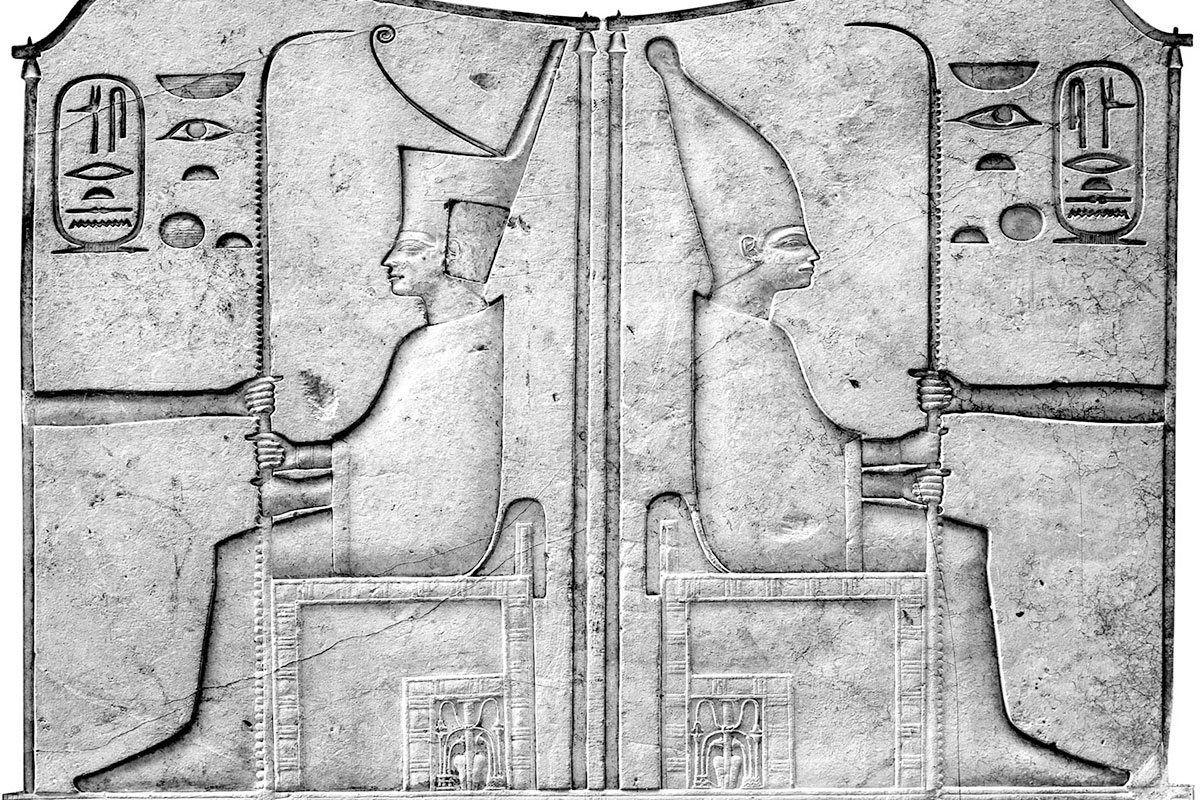
Narmer’s pivotal role in the unification of Egypt is widely accepted, supported by a wealth of archaeological artifacts and inscriptions. The most famous of these is the Narmer Palette, unearthed at Hierakonpolis. This artifact is more than just a relic, it’s a masterpiece of early propaganda. One side of the palette depicts Narmer wearing the White Crown, the symbol of Upper Egypt, while the reverse shows him adorned with the Red Crown, representing Lower Egypt. This imagery powerfully symbolizes his dominion over both lands. Behind him, marching soldiers and vanquished enemies at his feet underscore his military might. But Narmer’s significance extended beyond the battlefield. He became the embodiment of a ruler who achieved unity through a potent blend of military force, ritual authority, and divine endorsement. His royal crest, known as a serekh, associated him with the falcon god Horus, cementing the idea that kingship in ancient Egypt was intrinsically linked to both political power and the sacred.
Forging a Nation: The Mechanisms of Unification
Historians continue to explore whether Narmer’s unification of Egypt was the result of a single, decisive conquest or a more protracted process of power consolidation. Contemporary scholarship, including insights from researchers like Scott J. Allan and T. A. H. Wilkinson, suggests a multi-phase approach, with Narmer representing the culmination of a series of evolving political, economic, and military strategies. Key elements that likely contributed to this monumental feat included:
- Military Campaigns: Narmer is depicted as a formidable warrior, defeating enemies and subjugating rival centers, clearly illustrating the coercive aspect of state formation.
- Strategic Alliances: Evidence hinting at intermarriage and regional cooperation suggests that diplomacy and negotiation played as crucial a role as outright conquest in the unification of Egypt.
- Economic Integration: Gaining control over vital trade routes, fertile agricultural lands, and the Nile’s extensive resources allowed a centralized authority to consolidate its power effectively.
- Ideological Legitimation: The Narmer Palette and other artifacts served to portray the king as divinely sanctioned, employing religious iconography to communicate and reinforce his authority.
These combined factors, scholars argue, reflect the emergence of a sophisticated bureaucratic system capable of organizing labor, enforcing tribute, and coordinating large-scale projects, such as fortifications and early temples, further solidifying the unification of Egypt.
The Narmer Palette: A Masterpiece of Propaganda and Power
The Narmer Palette stands as a crucial visual record of the unification and the dawn of Egyptian statecraft. Scholars like B. P. Suelzle and Adriana Rossi have meticulously analyzed its intricate imagery. The use of composite perspective, where figures are depicted in hierarchical scale with Narmer towering over his subjects and enemies, visually reinforces the concept of supreme authority. The symbolic violence depicted, with enemies shown dismembered or trampled, was a deliberate display of power intended to legitimize Narmer’s rule and the newly unified state. Furthermore, the presence of ceremonial motifs, such as the intertwined serpopards (mythical creatures) and ritual scenes, may signify the merging of religious traditions from both Upper and Lower Egypt, symbolizing not just territorial integration but also cultural fusion. Far from being a simple historical account of a battle, the palette is a strategic piece of propaganda, demonstrating how Narmer and his successors masterfully used art to codify political memory, define legitimacy, and foster social cohesion during the critical period of the unification of Egypt.
Reshaping Governance and Belief: Political and Religious Implications
The unification of Egypt under Narmer initiated profound transformations that extended far beyond mere territorial consolidation. It fundamentally reshaped governance, religious practices, and the very structure of society. A centralized authority emerged, enabling standardized administration, taxation, and military organization across the newly formed nation. The practice of linking kingship directly to the god Horus established a powerful precedent for divine sanction, seamlessly integrating political and spiritual life for millennia to come. This era also saw significant cultural integration, as Narmer facilitated the creation of a shared Egyptian identity by merging symbols, rituals, and artistic styles from different regions. Crucially, the establishment of a single line of rulers created a dynastic precedent, ensuring continuity and tying political stability to the concept of inherited kingship. These ideological innovations, scholars note, profoundly influenced the entire trajectory of ancient Egyptian civilization, paving the way for monumental architecture, the development of hieroglyphic writing, and complex ritual systems that would define the civilization for thousands of years.
Beyond the Palette: Archaeological Corroboration
While the Narmer Palette is a cornerstone of evidence, multiple other archaeological findings corroborate Narmer’s historical role in the unification of Egypt. Serekhs, or inscribed royal crests found on pottery and stone objects, consistently identify Narmer and assert his authority across various regions. Excavations reveal evolving settlement patterns, indicating increased coordination in urban planning, fortifications, and infrastructure between Upper and Lower Egypt. The widespread dissemination of iconography and motifs, depicting warfare, ceremonial acts, and symbolic animals, further illustrates the merging of traditions and the legitimization of centralized rule. Moreover, the distribution of grave goods, particularly luxury items, suggests centralized control over production and trade networks, pointing to a political unification that extended well beyond military conquest. Together, these findings underscore that Narmer’s achievement was both practical—the organization of a functioning state—and symbolic—the creation of a shared identity and the legitimization of kingship during the unification of Egypt.
Ongoing Debates and Nuanced Perspectives
Despite Narmer’s iconic status as the unifier, some scholars propose that the unification of Egypt was a more gradual, multi-causal process rather than a singular conquest. For instance, Scott J. Allan challenges the interpretation of the Narmer Palette as a literal historical event, suggesting it might represent the culmination of prior consolidations and local alliances. Other ongoing debates include the possibility of multiple unifiers, with evidence suggesting rulers predating Narmer contributed to political centralization. The role of non-military factors, such as trade, religious authority, and economic incentives, is also considered to have played a significant role, potentially as impactful as armed conquest. Furthermore, archaeological layers sometimes reveal evidence of regional resistance, indicating that the process of unification was likely contested and evolved over time. These diverse perspectives remind us that the creation of the Egyptian state was a complex, negotiated, and ongoing endeavor, rather than a singular, instantaneous achievement.
The Enduring Legacy of Narmer and Early Egyptian Statehood
Narmer’s unification of Egypt left an indelible and profound legacy. By establishing the political framework of a unified nation, he set a crucial precedent for dynastic rule, allowing subsequent rulers to claim legitimacy by tracing their authority back to his achievements. He also institutionalized royal ideology, cementing the pharaoh’s role as both a political leader and a divine figure, a model that would endure for millennia. The establishment of a centralized administration became possible, enabling systematic bureaucracy, taxation, and labor organization. Furthermore, his actions fostered cultural cohesion, as the merging of Upper and Lower Egypt’s religious and artistic traditions laid the groundwork for a coherent Egyptian civilization. Later rulers, from Aha to the mighty pharaohs of the Old Kingdom, consistently referenced Narmer’s accomplishments, using his story as a cornerstone of Egyptian identity and a foundational model for governance, diplomacy, and military authority, all stemming from the pivotal unification of Egypt.
Conclusion: Narmer’s Lasting Significance in the Unification of Egypt
The unification of Egypt under Narmer stands as one of history’s earliest recorded political achievements, a remarkable synthesis of military strategy, religious ideology, and administrative foresight. While the narrative is undoubtedly imbued with myth and symbolism, the wealth of archaeological and iconographic evidence undeniably points to Narmer’s reign as pivotal in forging the framework for Egypt’s enduring civilization. By merging Upper and Lower Egypt, Narmer transformed the Nile Valley from a collection of independent polities into a centralized, ideologically coherent state, capable of monumental construction, sophisticated administration, and remarkable cultural continuity. His legacy, immortalized on stone, pottery, and ceremonial objects, continues to shape our understanding of state formation, leadership, and the very origins of complex society. Ultimately, the story of Narmer serves as a powerful reminder that the roots of civilization lie not only in agriculture and settlement but also in the vision, ambition, and leadership of individuals who could unify disparate peoples, establish enduring authority, and construct lasting symbols of power. In the riverlands of the ancient Nile, Narmer’s reign marks both the birth of the Egyptian state and the beginning of recorded history itself, forever linked to the unification of Egypt.