The Grim Truth: Warfare is Older Than Civilization Itself
Forget the idyllic images of early humans living in perfect harmony. For decades, a persistent myth suggested that hunter-gatherer societies were inherently peaceful, and that organized conflict, or “warfare,” only emerged with the advent of agriculture, private property, and social inequality. However, a wealth of archaeological evidence, painstakingly unearthed and analyzed, paints a starkly different picture. The narrative of human history, it turns out, is deeply intertwined with violence, predating writing, metal, and the very first walls ever constructed. This is the story of Shadows Before History, a confronting look at human conflict in the Paleolithic and Neolithic worlds.
Jebel Sahaba: A Cemetery of Perpetual Conflict
One of the most haunting pieces of evidence comes from Jebel Sahaba in Sudan, a cemetery dating back an astonishing 13,400 years. Here, archaeologists discovered dozens of skeletons bearing the brutal marks of conflict. Many were pierced by flint arrowheads, and numerous individuals displayed multiple healed and unhealed wounds. This wasn’t the result of a single, isolated incident, but rather a grim chronicle of violence experienced across generations. Some victims were children, and others died with projectiles still lodged within their bones, silent testaments to repeated attacks.
Recent forensic reassessments of the Jebel Sahaba site confirm a disturbing pattern. The evidence points towards ambushes, raids, long-distance projectile warfare, and potentially conflicts fueled by dwindling resources during a period of climatic instability at the end of the Ice Age. The people of Jebel Sahaba, though not soldiers in the modern sense, were undeniably caught in devastating cycles of hostility.
Paleolithic Hunter-Gatherers: More Than Just Peaceful Foragers
The discoveries at Jebel Sahaba are not isolated. Multiple Paleolithic sites across the globe reveal trauma patterns consistent with both interpersonal violence and intergroup conflict. These include blunt-force cranial fractures, indicative of attacks with clubs or thrown stones, and penetrating wounds from arrows or spear tips. Furthermore, the presence of defensive injuries on the arms and hands of skeletal remains strongly suggests active combat. The discovery of mass casualty layers, where entire groups were buried together, further challenges the romanticized notion of a peaceful Eden for early hunter-gatherers.
Instead, the archaeological record suggests that conflict was an intrinsic, albeit not constant, element woven into human evolution. Factors such as territorial pressure, the development of group identity, and competition for vital resources like water and hunting grounds likely shaped these recurring episodes of violence. The concept of Shadows Before History truly begins to take shape here, revealing a past far more complex and perilous than previously assumed.
The Neolithic Revolution: Intensified Conflict with Settlement
Contrary to earlier beliefs, the transition to the Neolithic period, marked by the adoption of agriculture and sedentary lifestyles, did not usher in an era of peace. In fact, it appears to have amplified conflict. When human groups began to settle, cultivate land, raise livestock, and store food, they created something entirely new: valuable assets that became targets worth fighting for. This shift fundamentally altered the dynamics of human interaction and competition.
Talheim Death Pit: An Organized Neolithic Massacre
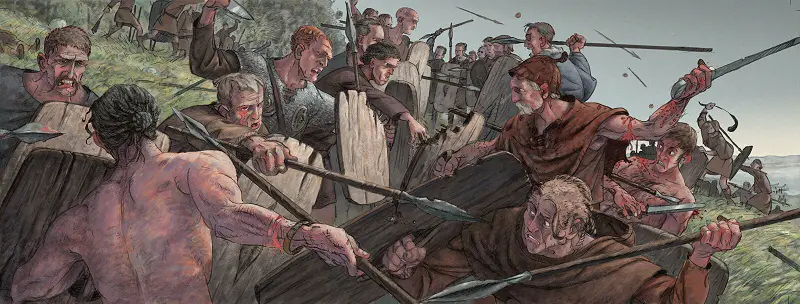
A chilling example of this intensified conflict is the Talheim Death Pit in Germany, dating to around 5000 BCE. This shallow burial site contained the remains of 34 individuals, including men, women, and children, all brutally slaughtered with blows to the head. The absence of defensive wounds on many victims suggests they were either executed or killed while attempting to flee. The attackers wielded stone adzes, powerful tools capable of crushing skulls. The victims belonged to the Linear Pottery Culture (LBK), one of Europe’s earliest farming communities. The massacre is interpreted as a raid by a rival community, likely driven by disputes over land, water, or population pressure. Talheim is not an isolated incident; numerous LBK communities across Central Europe show evidence of mass killings, fortified settlements, and systematic violence, painting a grim picture of the Neolithic era.
Alsace Mass Graves: Ritualized and Demonstrative Violence
Further evidence of organized violence comes from recent excavations in Alsace, France. Here, Neolithic pits yielded mutilated skeletons, including severed limbs and skulls that were smashed after death, indicating deliberate dismemberment. This was not impulsive brutality, but rather ritualized, demonstrative violence intended to send a powerful message. Archaeologists interpret these findings as indicators of early social complexity, where organized groups were capable of enacting punishment, intimidation, and displays of power. Warfare in the Neolithic was becoming less sporadic and more integrated into the dynamics of community life.
Weapons of War: The Evolution of Prehistoric Armament
Understanding prehistoric warfare also involves examining the evolution of weaponry. The question of what constitutes a “weapon” in these ancient contexts is crucial. While a sharpened bone could be used for hunting, and a stone axe for felling trees, in many Neolithic sites, these tools bear the unmistakable signature of combat. Marie-Hélène Dias-Meirinho’s research on Neolithic projectile points reveals clear adaptations for lethal encounters, such as elongated tips for deeper penetration, symmetrical designs for flight stability, and impact fractures consistent with striking human targets. These were not merely hunting implements, but tools specifically designed for interpersonal violence.
Similarly, stone adzes, clubs, and heavy axes exhibit distinctive patterns of use-wear and impact damage compatible with striking human skulls. Their concentration in certain sites, sometimes within male graves, suggests the emergence of a distinct warrior role in early farming societies. The development of these tools highlights the escalating nature of conflict and the increasing organization of violence, a key aspect of the Shadows Before History narrative.
Conflict Shaping Landscapes and Cultures
The impact of prehistoric warfare extended beyond individual skirmishes, leaving enduring marks on the very landscape. Studies in the “archaeologies of conflict” reveal that settlements were often strategically located on hilltops or in difficult-to-access terrain, featuring defensive ditches, palisades, and earthworks. The clustering of communities also suggests patterns of alliances and rivalries. Repeated layers of burning at archaeological sites often point to cycles of raids and destruction. The Neolithic world was far from static; groups moved, merged, fought, and replaced one another, frequently through violent means.
The disappearance of entire cultures in Europe, the Near East, and the Americas may not solely be attributed to peaceful diffusion, but rather to conflict-driven displacement. This global pattern underscores that the Shadows Before History were cast across continents.
Global Echoes: Prehistoric Conflict in the Americas
While much of the research on prehistoric conflict has focused on Africa, Europe, and the Near East, archaeological studies in Brazil offer striking parallels. Brazilian prehistory showcases skeletal trauma from projectiles, fortified hilltop sites, and clear evidence of raids and violent encounters. Some groups also exhibit evidence of ritualized violence and trophy-taking. This reinforces the understanding that conflict in prehistory was not a regional anomaly, but a global human behavior.
Why Did They Fight? The Deep Roots of Prehistoric Warfare
Researchers have identified several likely motivations behind prehistoric warfare. These include the defense of crucial territories and resources like rivers and hunting grounds for hunter-gatherers, and competition over fertile land for early farmers, where the loss of fields meant starvation. Population pressure, exacerbated by sedentary life and demographic growth, also created friction between neighboring groups. Periods of climatic instability, such as droughts, often correlate with increased violent trauma. Furthermore, strong social identities, the “us vs. them” mentality, and the need for alliances played a significant role. Finally, ritualized or punitive violence, intended to assert dominance or enforce social cohesion, also appears to have been a factor.
Rethinking the Myth of Prehistoric Peace
The accumulated archaeological evidence decisively discredits the outdated notion of a peaceful human origin. Violence was present in Paleolithic hunter-gatherer societies, and warfare became more organized and intense during the Neolithic. Massacres and raids occurred across continents, and weapons evolved in tandem with social structures. Conflict demonstrably shaped migration, settlement patterns, and cultural transformations. However, it’s crucial to note that violence was episodic, not constant. Prehistoric groups navigated long periods of peace, cooperation, and exchange, punctuated by moments of devastating conflict – a pattern that regrettably continues throughout human history.
Conclusion: Before Cities, There Was War, and Humanity
The story of prehistoric conflict, the enduring Shadows Before History, is not solely about violence. It is a narrative of survival, adaptation, identity, and the earliest, often fragile, attempts at community and belonging. The bones discovered in ancient graves are more than just records of death; they are the first silent chronicles of human courage, fear, hope, and struggle. Before the advent of cities, kings, or organized armies, humans were already grappling with the complexities of living together, and the ever-present risk of everything shattering. In essence, the Paleolithic and Neolithic worlds remind us that war is not a modern invention, but a shadow cast by our oldest memories, a burden carried for tens of thousands of years, revealing fundamental truths about our shared human experience.