The Opium Wars: How Britain’s Drug Trade Shattered Imperial China and Forged Modernity
History, it seems, rarely announces its arrival with a polite knock. In the mid-19th century, as the acrid scent of gunpowder mingled with the salty air above China’s Pearl River Delta, and the imposing silhouettes of British warships loomed on the horizon, the Middle Kingdom was not just facing an external foe. It was confronting the twilight of an ancient worldview, a hierarchical order that had defined its existence for centuries. The **Opium Wars** were far more than a dispute over a potent narcotic, they represented a brutal, unavoidable clash between two vastly different universes of meaning: one steeped in tradition, hierarchy, and a profound sense of self-importance, the other driven by an insatiable appetite for expansion, mercantile gain, and the raw power of industrial warfare.
From this cataclysmic collision, a new China began to emerge, and the world has been grappling with the profound consequences ever since. The **Opium Wars** were a pivotal turning point, forever altering the trajectory of both China and the global stage.
The Seeds of Conflict: Trade Imbalances and Imperial Arrogance
To truly grasp the genesis of the **Opium Wars**, one must first understand the immense self-perception that permeated the Qing Empire. For countless generations, China had not seen itself as merely one nation among many, but as the undisputed **Middle Kingdom**, the vibrant center of a cosmic hierarchy. Foreign powers were not viewed as equals, but as distant, often uncivilized, tributaries. Diplomacy was a carefully orchestrated ritual, not a genuine exchange between sovereign states, and trade was a carefully controlled concession, not a universally recognized right. This deeply ingrained worldview had served the empire well for centuries, functioning seamlessly until it encountered the rapidly industrializing West.
By the late 1700s, Great Britain found itself facing a significant economic quandary. The British craved the exquisite silks, the aromatic teas, and the delicate porcelain that flowed from China. However, China, in turn, had little desire for British manufactured goods. This persistent trade imbalance created a gaping wound in Britain’s economy, draining its silver reserves into Chinese coffers like an unstaunchable hemorrhage. The burgeoning might of British industry, while impressive, was being stifled by a lack of access to the vast Chinese market. To overcome this, Britain needed leverage, a means to force open the gates of the seemingly impenetrable empire.
Opium: The Poisonous Key to the Gates
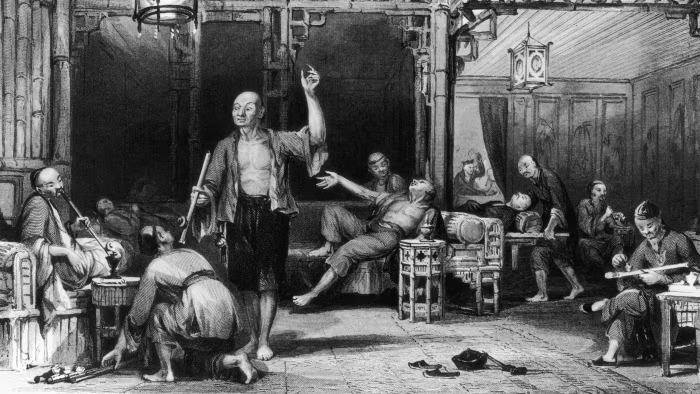
That leverage, tragically, came in the form of **opium**. Cultivated extensively in British-controlled India, the highly addictive drug was systematically smuggled into China, illicitly fueling widespread addiction across all strata of society. By the early 19th century, millions of Chinese citizens, including many high-ranking officials, had become dependent on the drug. This created a devastating dual crisis for the Qing dynasty: a burgeoning public health catastrophe and a crippling economic drain as silver now flowed in the opposite direction, enriching British merchants. When Imperial Commissioner Lin Zexu took the bold and decisive action of seizing and destroying thousands of chests of opium in 1839, he was not just enforcing existing laws, he was directly challenging Britain’s lucrative trade and its perceived authority.
What followed was the eruption of a conflict that neither side fully comprehended at the outset, yet both felt an almost inevitable destiny to engage in. The **Opium Wars** had begun.
The First Opium War (1839–1842): A Symphony of Gunboats and Humiliation
If one could imbue the past with sound, the First **Opium War** would undoubtedly commence with the deafening roar of naval cannon fire and the metallic clang of iron warships. Britain’s technological superiority was not merely an advantage, it was **decisive**. Steam-powered gunboats, the apex predators of the industrial age, effortlessly sliced through the antiquated defenses of the Qing navy. Chinese junks, armed with outdated cannons and crewed by poorly trained soldiers, were simply no match for the relentless onslaught. The conflict was mercifully brief, yet devastatingly impactful.
The resulting Treaty of Nanjing in 1842 was not a negotiation between equals, but a stark confession of defeat. China was compelled to cede the strategic island of Hong Kong to Britain, open numerous “treaty ports” to foreign trade and residence, grant extraterritorial rights to foreigners (meaning they were subject to their own laws, not Chinese ones), and pay a staggering indemnity. This treaty marked the ignominious beginning of what Chinese historians poignantly refer to as the **”Century of Humiliation”**. Tragically, the treaty did little to stem the flow of the opium trade, setting the stage for further conflict.
The Second Opium War (1856–1860): Empires Return for More Spoils
Western powers, having tasted victory and access, rarely exhibit restraint. A series of diplomatic disputes, most notably the **Arrow Incident**, provided Britain and France with the pretext they needed to launch a second, even more destructive, assault. The Second **Opium War** unleashed a wave of devastation that dwartfered the first. This time, Western troops marched directly into the heart of the empire, reaching Beijing itself. In a move of profound cultural vandalism, they looted and burned the Old Summer Palace, a priceless repository of Chinese art and history. Witnesses described the inferno as a funeral pyre, consuming the last vestiges of the Qing dynasty’s former glory.
The subsequent Treaties of Tianjin and Beijing further entrenched Western privileges. Opium was legalized, missionaries gained unprecedented access to the interior of China, more treaty ports were opened, and foreign embassies were established in the capital. New, massive indemnities were imposed, further crippling the Qing state. For countless Chinese intellectuals and reformers, these profound humiliations represented the irreparable cracking of the old world, a moment of undeniable reckoning.
Scholarly Perspectives: Beyond the Narcotic
Modern historians largely agree that the **Opium Wars** were not simply about the drug trade itself. Instead, they highlight a complex tapestry of deeper, interconnected forces. Several recurring themes emerge from extensive academic research:
1. Trade Access as the Primary Driver: Scholars like Gregory Blue and Julia Lovell emphasize that **opium was merely the instrument, not the ultimate motive**. Britain’s primary objective was to secure unfettered free trade, legal protections for its merchants, and access to China’s vast consumer base. The drug served as the “Trojan horse” that forced China’s gates open.
2. Agrarian Empire vs. Industrial Power: The **Opium Wars** starkly illustrated the chasm between China’s pre-industrial, agrarian economy and Britain’s dynamic, expansionist, and industrially advanced economy, backed by an unparalleled naval force. Economic analyses by scholars such as Wolfgang Keller and Carol Shiue reveal that these wars were part of a global pattern, where industrial powers imposed their modern trade systems upon less developed nations.
3. Qing State’s Structural Weakness Exposed: Historians like Xavier Paulès argue that **corruption, bureaucratic inertia, and a rigid, outdated ideology** rendered the Qing state incapable of effectively confronting the modern challenges posed by the West. The empire possessed immense cultural sophistication but critically lacked military modernization, a fatal imbalance.
4. Acceleration of Internal Collapse: The economic drain caused by the opium trade and the widespread addiction exacerbated existing social unrest within China. This weakness is seen as a contributing factor to the **Taiping Rebellion**, one of the bloodiest conflicts in human history. Some scholars connect the **Opium Wars** to decades of cascading internal disasters that further destabilized the empire.
5. The Genesis of Modern China: Ironically, the very humiliations inflicted by the West paradoxically sowed the seeds for China’s eventual resurgence. The **Opium Wars** catalyzed the emergence of new thinkers, reformers, and revolutionaries who were deeply committed to rebuilding a China strong enough to resist foreign domination and chart its own course.
Global Repercussions and the Dawn of a New World Order
The impact of the **Opium Wars** extended far beyond China’s borders, fundamentally reshaping the global order. These conflicts served as a **blueprint for Western expansion across Asia**. The success Britain and its allies achieved in China emboldened them to impose similar “unequal treaties” on other Asian nations, including Japan, Thailand, and Korea, ushering in an era of intense **new imperialism**. The **Opium Wars** were, in essence, the prototype for a century of colonial domination.
Furthermore, the wars significantly **weakened the Qing dynasty**, exposing its vulnerabilities and directly contributing to its eventual collapse in 1911. Perhaps most significantly, the shared experience of humiliation forged the foundations of **modern Chinese nationalism**. The identity of a unified, centralized China, inherently wary of foreign interference, was born from the ashes of these devastating conflicts.
The **Opium Wars** also permanently shaped China’s complex and often fraught relationship with the West. To this day, the memory of this period profoundly influences Chinese diplomacy. Every contemporary dispute involving sovereignty, trade, or foreign military presence is viewed through the prism of this historical trauma, a constant reminder of past exploitation.
The Enduring Legacy: “Never Again”
Stroll through the bustling streets of modern Beijing, Shanghai, or Guangzhou, and you will feel the palpable pulse of a nation fiercely determined never again to allow external forces to dictate its destiny. The towering skyscrapers stand as steel vows, and the state speaks with the confident resonance of an empire reborn. From a geopolitical perspective, the **Opium Wars** provide critical context for understanding:
- China’s acute **sensitivity to foreign interference**.
- Its unwavering **obsession with sovereignty and national dignity**.
- Its relentless **drive for technological self-sufficiency**.
- Its strategic **pursuit of naval power**.
- Its firm **insistence on controlling its internal markets**.
China’s leadership frequently invokes the **”Century of Humiliation”** as a stark reminder that national weakness inevitably invites exploitation. Whether discussing sensitive issues like Taiwan, the South China Sea, cybersecurity, or ongoing trade disputes, the unspoken, underlying narrative remains consistent: **”Never again.”**
History’s Broken Mirror
The **Opium Wars** were far more than mere military engagements, they were a brutal, fiery enlightenment. China, through the stark reality of gunpowder and cannon fire, was forced to confront a transformed world that would not wait for its assimilation. Britain, in turn, learned that the pursuit of empire carried a profound cost, one that would eventually manifest in moral, political, and historical repercussions. In the fractured mirror of the **Opium Wars**, we see the reflection of the world that followed: the rise of global capitalism, the era of industrial imperialism, and the undeniable birth of modern China. A China whose ascendance in the 21st century is inextricably linked to the deep scars etched into its psyche during the tumultuous 19th century. These wars were, undoubtedly, tragedies, but they were also undeniable turning points, events that irrevocably reshaped the map of human destiny.