China and Taiwan: Decoding 150 Years of Conflict, Strategic Stakes, and a Looming Confrontation
The complex and enduring geopolitical dispute between **China and Taiwan** remains one of the most significant flashpoints in the modern era. While current headlines often highlight military drills and diplomatic maneuvers, the roots of this conflict run deep, stretching back over a century. Understanding these historical origins is crucial to grasping why the issue persists and why it carries such profound global implications.
Historical Roots: From Imperial Control to Civil War’s Aftermath
Taiwan’s relationship with mainland **China** has historically been dynamic. During the Qing Dynasty, Taiwan was incorporated into the Chinese imperial system, though its actual control fluctuated. It was considered a peripheral territory, not a central focus of the empire. This perception shifted dramatically in 1895 when **China**, after losing the First Sino-Japanese War, ceded Taiwan to Japan under the Treaty of Shimonoseki.
Japan’s fifty-year rule profoundly reshaped Taiwan’s infrastructure, economy, and administrative systems. The island developed separately from the turbulent political changes occurring on the mainland. Following Japan’s defeat in World War II, the Allied powers agreed that Taiwan would be placed under the administrative control of the Republic of China (ROC), then led by Chiang Kai-shek and his Nationalist Party (Kuomintang).
However, this post-war arrangement proved short-lived. **China** was soon engulfed in a brutal civil war between the Nationalists and the Communists, led by Mao Zedong. In 1949, the Communists emerged victorious, establishing the People’s Republic of **China** (PRC) on the mainland. The defeated Nationalists retreated to Taiwan, establishing a government in exile and maintaining their claim as the legitimate rulers of all of **China**, not the Communists.
This created a political paradox that continues to this day: two governments claiming to represent the same nation, with the PRC governing the mainland and the ROC governing Taiwan.
Cold War Dynamics and Shifting International Recognition
The **China and Taiwan** issue quickly became entangled in the global ideological struggle between the United States and the Soviet Union. Washington provided significant military and economic aid to the ROC on Taiwan, recognizing it as the legitimate government of **China** for decades. Meanwhile, the PRC solidified its communist rule, expanded its influence, and worked to diplomatically isolate Taiwan.
A pivotal moment arrived in 1971 when the United Nations voted to recognize the PRC as the sole representative of **China**, expelling the ROC from the organization. This was followed by the U.S. decision in 1979 to formally establish diplomatic relations with Beijing. Crucially, the United States simultaneously enacted the Taiwan Relations Act, ensuring continued support for Taiwan’s self-defense and maintaining unofficial yet substantial ties.
At the core of the dispute lies a fundamental disagreement over sovereignty. The PRC steadfastly adheres to the “One **China** Principle,” asserting that Taiwan is an inalienable part of its territory. Conversely, Taiwan functions as a de facto independent state, boasting its own constitution, government, military, and democratic institutions. This unresolved sovereignty question remains the central point of contention in the **China and Taiwan** dynamic.
The Rise of a Distinct Taiwanese Identity
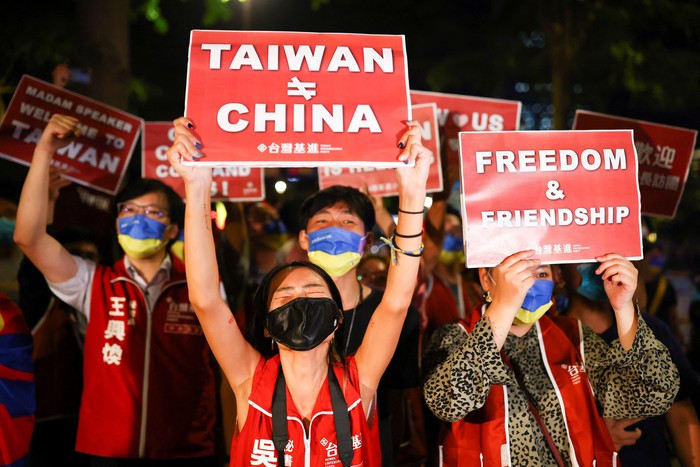
While the political division after 1949 set the stage for current tensions, demographic and cultural shifts over the decades have further widened the divide. Under martial law, Taiwan was once dominated by the Nationalist Party, which promoted a “Chinese” identity. However, as Taiwan democratized in the 1980s and 1990s, a distinct Taiwanese identity emerged, one not contingent on political or cultural unity with the mainland. Today, polls consistently indicate that a growing majority of people in Taiwan identify themselves as “Taiwanese” rather than “Chinese.” This evolving national identity poses a significant challenge to Beijing, which views any move toward formal independence as an unacceptable red line.
Strategic Significance: Why Taiwan Matters to China Today
Beyond historical and ideological factors, Taiwan holds immense strategic value for **China**. Its geographic location positions it as a critical component of the “First Island Chain,” a string of territories extending from Japan to the Philippines. For **China**’s military planners, breaching this chain is essential for projecting naval power and diminishing American influence in the Western Pacific. Economically, Taiwan is a global leader in semiconductor manufacturing, producing the world’s most advanced chips. Beijing views technological dominance as vital for its long-term national objectives. In theory, unification could grant **China** access to some of the world’s most sophisticated manufacturing capabilities, though the risks of disruption make this outcome far from certain.
Symbolically, the issue is deeply intertwined with the legitimacy of the Chinese Communist Party. Xi Jinping has repeatedly stated that the “reunification of the motherland” is central to **China**’s rejuvenation. Abandoning the claim to Taiwan would be politically unthinkable.
The Current Standoff: A Precarious Balance
Cross-strait relations today are characterized by a delicate and precarious balance. Taiwan continues to operate independently, strengthening its democratic institutions and asserting its distinct identity. In response, **China** is increasing military pressure, conducting regular air and naval operations near the island. The United States, meanwhile, maintains a policy of strategic ambiguity, supporting Taiwan’s self-defense without explicitly committing to direct intervention. This balance is fragile. **China** believes time is on its side, given its growing military and economic power. Taiwan feels that time strengthens its identity and democratic foundations. The U.S. strives to deter conflict without provoking it.
Future Prospects: How Likely Is a Conflict Over China and Taiwan?
Predicting whether the **China and Taiwan** conflict will escalate into open war is challenging, but analysts often discuss several potential scenarios. The most likely scenario in the near term is a **peaceful status quo**. For the foreseeable future, all parties stand to benefit from avoiding war. Taiwan thrives under the current arrangement. **China** prefers to sidestep the catastrophic diplomatic and economic consequences of a conflict. The U.S. seeks stability in a region vital to global trade. This scenario could persist for decades, provided no side attempts a drastic shift.
Another possibility is **coercive pressure without war**. **China** may intensify efforts to intimidate Taiwan through increased military exercises, cyberattacks, economic blockades, and diplomatic isolation. The aim of this pressure is to weaken Taiwan psychologically and erode confidence in U.S. support.
A third scenario involves **limited conflict or blockade**. If Beijing concludes that peaceful reunification is impossible, it might attempt a blockade or a series of limited military actions designed to force negotiations rather than a full-scale invasion. While risky, this approach would be less costly than an amphibious assault.
The **full-scale invasion** remains the least likely but most dangerous scenario. Such an operation would be one of the most complex and perilous military undertakings imaginable. It could result in massive casualties, devastate Taiwan’s infrastructure, draw in the United States and its allies, and destabilize global supply chains. While **China** is developing the capability to attempt such an operation, the associated costs remain exceptionally high.
The **China and Taiwan** conflict is far more than a territorial dispute. It represents the convergence of history, identity, ideology, strategic geography, and great-power rivalry. Its origins trace back to imperial **China** and the political upheavals of the 20th century, but its future implications extend to the stability of the entire Asia-Pacific region. Whether this conflict will erupt into open war depends on shifting calculations of risk, power, and political identity. For now, the uneasy status quo endures. However, as **China** grows more assertive, Taiwan becomes more distinct, and global tensions rise, the fragile peace across the Taiwan Strait will continue to be one of the world’s most critical geopolitical fault lines.