Pam Bondi says, “we will do everything in our power to seek the death penalty,” as two National Guard members remain in critical condition after the attack near the White House
Federal and local prosecutors said they will pursue the harshest possible punishment after two members of the National Guard were shot while on duty near the White House. The suspect, identified as Rahmanullah Lakanwal, a citizen of Afghanistan who, authorities say, arrived in the United States in 2021, was also wounded and hospitalized after Wednesday’s attack, which briefly put the seat of government into lockdown.
What prosecutors said, in their words
In an interview on Thursday, Attorney General Pam Bondi said the two Guard members “survived surgery,” but she declined to provide further medical details. Bondi added that charges will depend on the victims’ medical prognosis, and she warned that the government will seek the most severe penalties if one or both do not survive. Bondi said, translated from her original remarks, “At this time, we will base the charges on their prognoses. Both underwent surgery. I will not speak about their health condition now. We are praying for their recovery, but, in the worst case, the minimum sentence will be life imprisonment with terrorism charges. If something happens, I will say this now, we will do everything in our power to seek the death penalty against this monster who should not be in our country.”
Jeanine Pirro, the prosecutor for the District of Columbia, said the two service members are in “critical condition,” and she noted that preliminary charges include “three counts of assault with intent to kill.” Pirro emphasized prosecutors will monitor the victims’ conditions closely, and that additional charges could follow depending on how the case develops.
Investigators, intelligence details, and official reactions
Federal officials said the FBI is treating the case as a terrorism investigation while local prosecutors pursue assault and related charges. The CIA director, John Ratcliffe, stated that the suspect “worked with the U.S. government, including the CIA, as a member of a partner force in Kandahar” during the Afghanistan war. The FBI director, Kash Patel, said the terrorism inquiry is ongoing.
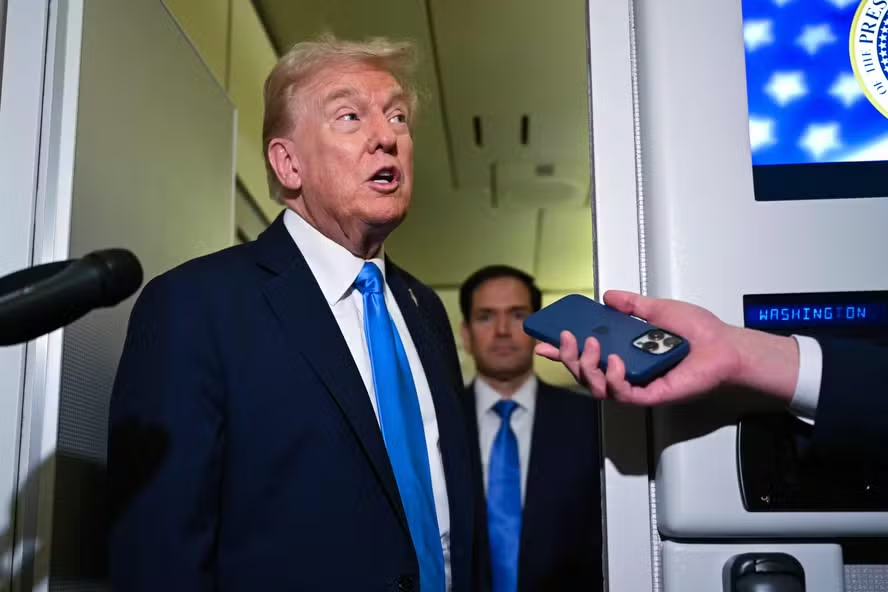
President Trump, who was not in Washington at the time, denounced the attack on social media, calling the shooter an “animal” who “will pay a very high price.” Authorities said the two Guardsmen had been deployed to Washington by federal order issued by the president, and that they were serving during the Thanksgiving period after volunteering to work the holiday shift.
Who was targeted, and why the Guard was in Washington
The victims were National Guard members assigned to protect the area around the White House and support local security operations. Officials said one of the wounded was a “young” guard who had volunteered to work on the Thanksgiving holiday so others could be home with family. Bondi said, “She volunteered, like many of those guards, so others could be home with their families, but now her family is in a hospital room with her while she fights for her life.”
The current Guard deployment to Washington began after a federal order in August, when more than 2,000 Guard members were sent to the capital to support local law enforcement and protect federal buildings. That mobilization drew pushback from Washington’s mayor, Muriel Bowser, who described the intervention as “alarming and unprecedented.” A federal judge recently ordered an end to the operation, but then stayed that decision for 21 days to give the federal government time to withdraw troops or appeal.
Legal path forward and the focus on the death penalty
Local prosecutors have already filed assault charges, including the three counts of assault with intent to kill that Pirro referenced. Bondi and other federal officials said terrorism charges are likely to be added. Bondi made clear that in the event one of the injured Guard members dies, the federal government, “in the worst case,” will pursue the death penalty, and that the default minimum penalty would be life imprisonment with terrorism charges.
That stance puts the case on a fast, high-profile legal track, combining local violent-crime statutes with federal terrorism statutes that can carry the death penalty in aggravated cases. Prosecutors said they will continue to monitor the victims’ medical conditions, and that further decisions about charges and sentencing will be guided by how those conditions evolve.
The suspect, Lakanwal, remains hospitalized and under guard. Authorities say he was armed with a revolver in the attack, and that he also sustained injuries. Investigators continue to probe motive, and federal and local agencies are coordinating the inquiry.
What this means for security in the capital
The shooting has renewed debate about the presence and role of the National Guard in Washington. The Guard is normally responsible for state-level support missions, but it can be federalized for national emergencies and special operations. During the current mobilization, Guard troops have been posted around key federal sites to assist the Secret Service and local police with patrols and perimeter security. The Secret Service remains the primary agency responsible for the day-to-day security of the White House complex.
Authorities said they are continuing to secure the area and review tactical procedures. The community and elected officials have responded with concern, both for the wounded service members and for the broader questions the attack raises about security, vetting, and the legal consequences for violent acts near federal sites.
Federal prosecutors, investigators, and local officials said they will release more details as the investigation proceeds and as the victims’ medical conditions become clearer. For now, a central thread of the official response is clear: with two Guardsmen gravely wounded and terrorism allegations under review, prosecutors have publicly signaled they may seek the death penalty if the victims do not survive.