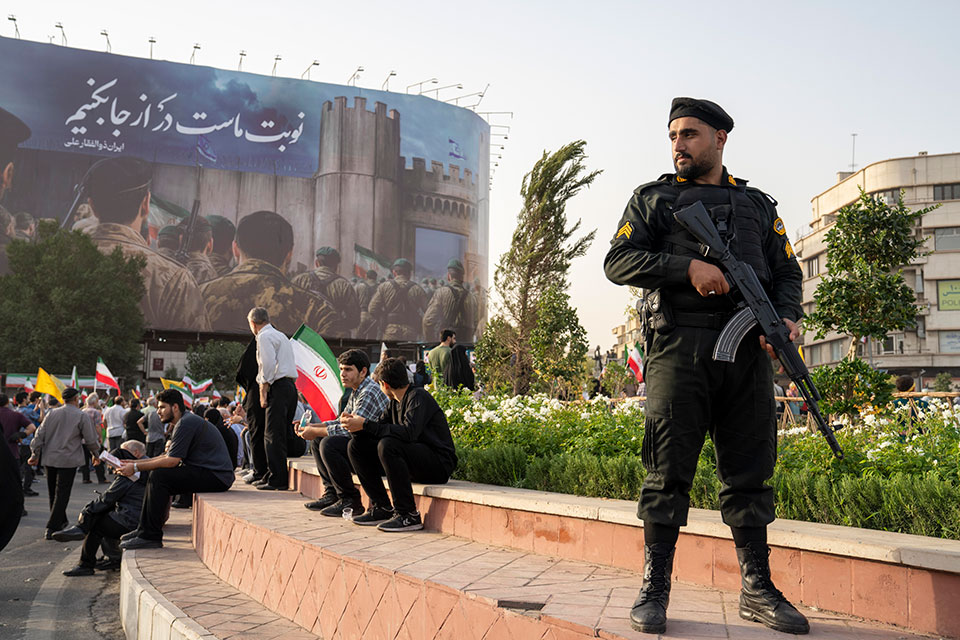
A theology-first strategy for the Iranian Revolution to reclaim popular trust, curb executions, and survive into a new era of restraint
The question facing the Iranian Revolution today is less military, and more moral, than many international commentators assume. After four and a half decades of rule, the Islamic Republic’s endurance has been damaged not just by sanctions and isolation, but by the repeated use of the most extreme punishments. That pattern has turned the state’s security reflex into a symbol of governance, not of justice. A different path exists within the same Shiʿi tradition that birthed the Revolution: one that would see the Republic renounce the death penalty, including for apostasy, on theological grounds, and in doing so, rebuild its own legitimacy.
Shiʿism between power and restraint
The Revolution’s legal-theological pivot was Ayatollah Khomeini’s theory of velayat-e faqih, a move that allowed clergy to govern in the Imam’s absence. That innovation fused religious ritual with state institutions, and it gave the Islamic Republic a unique claim to indigenous legitimacy. Yet, the same Shiʿi jurisprudential tradition contains powerful counsels of restraint. For centuries many Shiʿi jurists argued that the full application of hudūd punishments properly belongs to the infallible Imam, and as a result, a deep suspicion of rulers who apply irreversible penalties has long existed within the tradition.
The famous injunction to “ward off hudūd by doubts” is not a marginal note in this conversation. It is a moral instinct that counsels delay, hesitation, and caution when a state contemplates death or mutilation in the name of religion. Voices inside Iran’s clerical establishment have used versions of that argument to protest the routine use of execution as a tool of political control. These arguments are internal to Shiʿism, not borrowed from external critics, and they provide a theological basis for reform that does not amount to secularization.
Death, apostasy, and the high cost of rigidity
The insistence on capital punishment has become part of the Republic’s political identity. By most counts, Iran executed around 863 people last year, a figure that has reinforced a global image of the state as punitive and uncompromising. For young Iranians, many of whom were born after the Revolution, televised executions and public hangings are a recurring sign that the state is prepared to respond to dissent with finality. That approach generates martyrs as surely as it creates fear, and martyrs feed cycles of private hatred that can last generations.
From a tactical perspective, the rope has not prevented waves of protest. Quite the opposite, state violence has often escalated dissent. The Iranian Revolution, which claimed to defend the oppressed and the dispossessed, risks hollowing out that claim by making punishment the center of governance. The cost of rigidity is not only measured in lives lost, but in the erosion of popular consent that underpins any durable political order.
An Islamic Republic without the rope
Crucially, renouncing the death penalty would not require a doctrinal leap outside Shiʿism. The theological resources for restraint are present in the tradition: the ambiguous historical evidence for apostasy executions, the Qurʾanic emphasis on forgiveness, and the long-standing Shiʿi caution about applying hudūd punishments in the Imam’s absence. A Leader, if he chose to act, could frame a change not as capitulation to Western pressure, but as the faithful application of Shiʿi principles in an era of uncertainty and modern criminal procedure.
Practically, a formal declaration would say that hudūd punishments that destroy life or limb are not to be applied during the Occultation, and that qiṣāṣ in murder cases would remain a legal category but with forgiveness and compensation as the preferred outcome. Apostasy would cease to be a criminal charge, and religious belief would be treated as the domain of individual conscience. Such a move would not make Iran a liberal democracy overnight, but it would remove the gallows from the state’s most visible posture, and it would signal a willingness to exercise self-limitation rather than permanent coercion.
Why restraint could increase the Revolution’s durability
Renouncing executions could strengthen the three elements that historically sustained the Iranian Revolution: anti-imperialism, cultural authenticity, and a promise of social justice. A shift away from capital punishment would be an internally generated reform, rooted in Shiʿi jurisprudence, that could restore some trust among young Iranians and the religious middle classes. It would show that the system can correct itself from within its own intellectual wellsprings, a demonstration of maturity that could reduce polarization and the creation of new martyrs.
Internationally, a non-executing Islamic Republic would be harder to paint as a medieval hangman, while remaining assertive and sovereign in foreign policy. Domestically, it could ease the intergenerational fracture that now deepens every time a young protester is publicly executed. By choosing restraint, the state could begin to recover moral capital, and replace short-term security theatrics with a longer-term strategy of consent.
The debate is not theoretical. Critics inside the system, such as Ayatollah Montazeri during the post-revolutionary period, argued that executions cheapen religion and that an Islamic state risks becoming a tyranny if it treats killing as a reflex. These critiques are part of the Revolution’s internal conversation, and they point to a reform path that is theologically coherent, politically strategic, and socially urgent.
In the end, the survival of the Iranian Revolution may depend less on its capacity to threaten death, and more on its willingness to practice mercy, and to anchor state power in restraint rather than spectacle. Choosing not to shed blood would not be a sign of weakness, it would be a declaration of the Revolution’s confidence in its own theological tradition, and its readiness to outgrow habits that have damaged its claim to represent the dispossessed.
The question for Iran’s leaders is whether they will risk short-term disquiet inside the security apparatus to win longer-term endurance among the people. If the Revolution chooses to reform from within, by renouncing the death penalty and the criminalization of belief, it could yet reinvent its claim to legitimacy for a new generation.