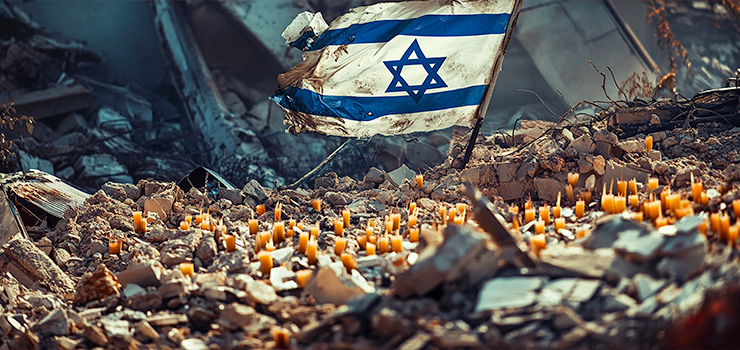
A clear-eyed look at OCTOBER 7, the intelligence gaps behind the assault, probe findings, and the political fallout for Israel and its leaders
The morning of OCTOBER 7 exposed a bitter paradox, the kind that rewires national narratives. For years Israel’s defense posture rested on a powerful claim, that superior sensors, drones, cyber tools, and layered missile defenses would prevent strategic surprise. The image of rockets intercepted by the Iron Dome became a shorthand for invulnerability. Yet on OCTOBER 7 a coordinated assault by Hamas, using paragliders, motorcycles, boats, drones, and mass infiltrations, produced catastrophic results. According to reporting, the attack left “at least 1,195 people killed and around 251 taken hostage.”

The myth of technological hegemony and its cultural cost
Israel’s investment in high-end defense systems is real and deep. One analysis noted that, “Israel is an example of a country with inherent technological superiority throughout its close surroundings.” That edge, in missile defense layers from Iron Dome to David’s Sling and Arrow, in Unit 8200’s signals collection, and in an expanding drone and cyber fleet, shaped a national doctrine. The consequence was not only better equipment, it was a mindset, a belief that data and interceptors could substitute for messier, human layers of judgment.
As Yoav Fromer of Tel Aviv University put it, the visible success of these systems delivered psychological effects, because the system provided “both a physical and a psychological solace that enables Israelis to go about their business.” That solace, however, also bred complacency. Critics observed the rise of a modern doctrine in which, in their words, “technology will hold the line,” and in some corners this became the default assumption rather than one input among many.
How OCTOBER 7 happened despite the sensors
On the ground, the assault demonstrated that a lot of technical collection does not guarantee correct interpretation. Multiple inquiries and reporting point to layered failures. Some sensors did pick up worrying activity, and Unit 8200 reportedly picked up a Hamas training exercise that mirrored the eventual attack, including hostages and infiltration of a mock outpost. Yet those signals were not translated into decisive action.
A central finding from investigations was a failure of analysis and imagination. Analysts had accepted a prevailing assumption that Hamas would be deterred from large ground incursions, that it would stick to rocket fire, or that the border infrastructure would be sufficient to prevent penetration. The official inquiry put it starkly, citing the commission report summary, “The army knew, but didn’t believe; … We were addicted to precise intel — which we failed to interpret.” That sentence captures the cognitive gap between data collection and the human work of framing, challenging assumptions, and preparing for unlikely, but possible, scenarios.
What the probes and documentation revealed
Post-attack reviews documented concrete weaknesses. The military inquiry reported that the border barrier and surveillance systems created a false sense of security, and that the assault breached some 60 points in the fence in southern Gaza. The domestic intelligence agency Shin Bet concluded that long-standing policies of containment and tacit arrangements had allowed Hamas to entrench and gain resources while the policy prioritized calm over disruption.
Investigators also flagged that funds flowing into Gaza, including money from mediators, were not always monitored effectively, and that some of those resources were diverted into military infrastructure. Together, the documentary record portrays not a single failed sensor, but a system of assumptions, policy choices, and analytic habits that left blind spots.
Political shockwaves, resignations, and public anger
The fallout from OCTOBER 7 was immediate and political. Senior security figures stepped down amid the uproar, with reporting noting that Maj. Gen. Aharon Haliva resigned as head of military intelligence, and that Lt. Gen. Herzi Halevi also left his post. Polling reflected the depth of public anger and doubt: one survey found that 87% of Israelis believed the prime minister should “accept responsibility for the events of October 7”. Yet political consequences are complex; analysts have noted that Prime Minister Benjamin Netanyahu remained politically resilient, at least in the short term, even as fissures in coalition partners and public trust widened.
Strategically, the event forced a re-evaluation. Military and policy debates shifted from purely technical upgrades toward organizational reforms, analytic culture changes, and tougher scrutiny of assumptions. Observers warned that the concept that “technology will hold the line” risks being, in their words, “the 2023 equivalent of that failed idea,” if not balanced with human judgment and institutional flexibility.
OCTOBER 7 thus became a test of whether institutions can learn from high-cost surprises. The challenge is not only replacing leaders but rebuilding analytic practices, strengthening cross-agency challenge mechanisms, and restoring a civic conversation about the trade-offs in containment policies and the risks they bring.
Lessons and the hard path ahead
The hard lessons after OCTOBER 7 are plain. Technology is vital, but insufficient. Sensors and interceptors can reduce risk but cannot eliminate human error, groupthink, or policy blind spots. Adversaries adapt, and non-state actors increasingly combine low-tech surprise with higher-end capabilities like drones and missiles. The margin of Israel’s qualitative edge may be narrowing, and planning must now assume that enemies will seek to exploit the seams between sensors, analysts, and decision-makers.
Restoring deterrence will mean more than new interceptors. It will require cultural change inside intelligence and defense bodies, clearer political oversight, better tracking of resource flows into hostile areas, and a willingness to test and entertain worst-case scenarios. As one critical line from the inquiries reminds policymakers, having the clearest lens is useless if you do not frame the shot correctly.
The optics of the conflict remain striking: the sight of interceptors in the sky can reassure a population, but the memory of OCTOBER 7 is a reminder that the costs of surprise are human and political. Israel’s path forward depends on whether it translates that shock into genuine institutional humility, and whether leaders accept not only blame, but deep reform. Only then can technology regain its role as a force-multiplier, rather than a seductive substitute for tougher, often uncomfortable, political and analytic work.
ALEXANDRE ANDRADE – “FalloutObserver”