When Loyalty Is Assumed
Counterintelligence failures are rarely technical. They are institutional. They emerge when organizations adopt assumptions about loyalty that are no longer examined, challenged, or tested. Once embedded, these assumptions become blind spots. When those blind spots coincide with power, status, or identity, counterintelligence ceases to function.
The Cambridge Five was not an isolated espionage success by Soviet intelligence. It was the predictable outcome of a British counterintelligence system that treated social class as a proxy for allegiance. The damage that followed was not accidental. It was structural.
This case remains relevant because the same logic persists in modern institutions, under different labels.
Operational Context
The recruitment of the Cambridge Five occurred in a period of ideological instability. Liberal democracies appeared fragile. Fascism was expanding. Communism attracted segments of the intellectual elite who perceived it as historically inevitable rather than subversive.
British intelligence institutions were shaped by class continuity. Entry into the Foreign Office and MI6 followed social pathways that prioritized background over verification. Loyalty was inferred from education, accent, and network affiliation.
Counterintelligence focused outward. Internal threat was considered improbable. Vetting existed, but it was informal and static. Continuous assessment was absent.
Soviet intelligence identified this condition accurately. The vulnerability was not operational. It was cultural.
Mechanics of the Penetration
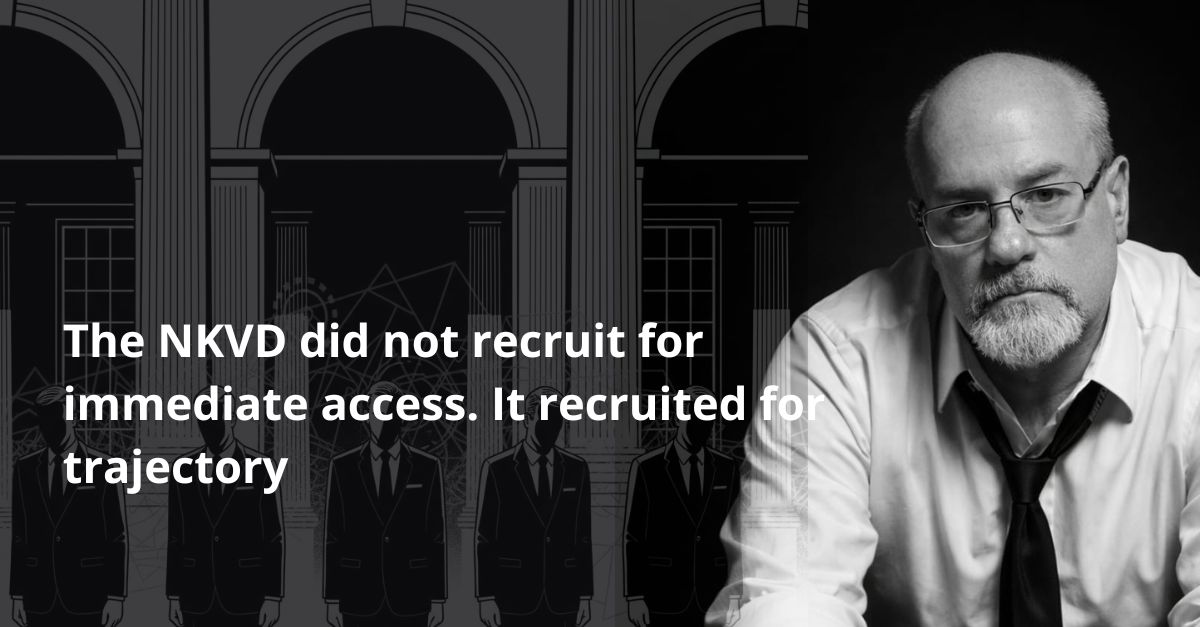
The NKVD did not recruit for immediate access. It recruited for trajectory.
Philby and the others were selected for ideological alignment and long-term potential. They were instructed to suppress visible political activity, integrate fully into establishment institutions, and avoid behavior that would attract attention. Tasking was limited. Communication was controlled. Patience was enforced.
This approach neutralized conventional counterintelligence indicators. There were no abrupt changes in lifestyle, no financial anomalies, no operational recklessness. Normal behavior became the concealment mechanism.
Philby’s rise into senior counterintelligence roles within MI6 completed the penetration cycle. The individual responsible for detecting Soviet operations was, in practice, serving Soviet intelligence.
At that point, counterintelligence had inverted.
Institutional Failure
Warning signs accumulated over time. Operations failed systematically. Assets were exposed with consistency. Patterns emerged.
They were not acted upon decisively.
Investigations were constrained by hierarchy, reputation, and social symmetry. Senior officers hesitated to challenge individuals who mirrored their own background. The cost of accusation was perceived as higher than the cost of inaction.
Counterintelligence was subordinated to institutional comfort.
This was not a lack of information. It was a lack of authority to confront internal power.
Strategic Impact
The value of the Cambridge Five to Soviet intelligence was not limited to access. It extended to anticipation.
Through their positions, Soviet services gained visibility into Western priorities, operational planning, liaison dynamics, and strategic assessments. Western actions were understood before execution. Risk thresholds were mapped. Decision-making patterns were observed.
This level of penetration produces distortion at the strategic level. Policy is shaped under false assumptions. Operations are designed on compromised ground.
The adversary does not react. It pre-empts.
Doctrinal Lesson 1: Vetting Is Not Clearance
British counterintelligence treated vetting as an entry requirement rather than a continuous process. Once admitted, individuals were effectively exempt from reassessment.
Counterintelligence doctrine requires ongoing evaluation. Loyalty is not static. Ideology evolves. Affiliations shift. Absence of reassessment creates temporal blind spots.
Clearance without continuity is exposure.
Doctrinal Lesson 2: Status Is a Vulnerability
Class, rank, and credential functioned as informal immunity. Individuals who “belonged” were shielded from suspicion.
Modern equivalents are well known: seniority bias, founder privilege, academic prestige, technical indispensability.
Counterintelligence requires symmetry of scrutiny. Any category exempt from suspicion becomes an attack surface.
Doctrinal Lesson 3: Ideology Outlasts Incentive
The Cambridge Five were not financially motivated. They were ideologically committed.
Ideological motivation is durable. It tolerates delay, risk, and isolation. Counterintelligence programs focused primarily on financial indicators systematically underestimate this vector.
Ideology must be treated as a primary CI variable.
Doctrinal Lesson 4: CI Must Be Structurally Independent
Counterintelligence failed because it lacked institutional autonomy. It could not override social pressure or reputational concern.
Effective CI requires independence, direct access to leadership, and protection from political consequence. Without these conditions, CI becomes procedural rather than operational.
Contemporary Relevance
Cambridge-style penetrations now occur in technology firms, research institutions, advisory environments, and strategic industries. The language has changed. The mechanism has not.
Cultural alignment is still mistaken for loyalty. Identity is still confused with allegiance.
Organizations that assume internal trust do not prevent penetration. They delay its discovery.
Final Reflection
The Cambridge Five succeeded because counterintelligence was constrained by belief rather than evidence.
The most dangerous failure in counterintelligence is not ignorance.
It is certainty.
When loyalty is presumed, verification stops.
When verification stops, penetration becomes inevitable.
ALEXANDRE ANDRADE | Counterintelligence & Strategic Intelligence Analysis