How the Steve Witkoff Russia peace plan emerged from October calls and back-channel diplomacy
Steve Witkoff Russia peace plan negotiations drew scrutiny after a Bloomberg transcript showed the U.S. special envoy for the Middle East speaking directly with the Kremlin on October 14, about a proposed settlement for the war in Ukraine. The call, recorded and reviewed by Bloomberg, included Yuri Ushakov, President Vladimir Putin’s foreign policy adviser, and it set out a blueprint that later echoed in a 28-point peace framework that Washington pushed as a basis for talks.
What the transcript reveals
The transcript, published by Bloomberg, records a frank exchange in English, in which Mr. Witkoff and Mr. Ushakov discussed shaping a text Russia could present to then-President Trump. According to the transcript, Witkoff proposed modeling the Ukraine proposal on a recent Gaza agreement, and he offered specific territorial ideas. In the conversation, Mr. Witkoff said, “Between us, I know what it will take: Donetsk and maybe an exchange of territories”, a line that underlines how territorial concessions were discussed early in the back-channel talks.
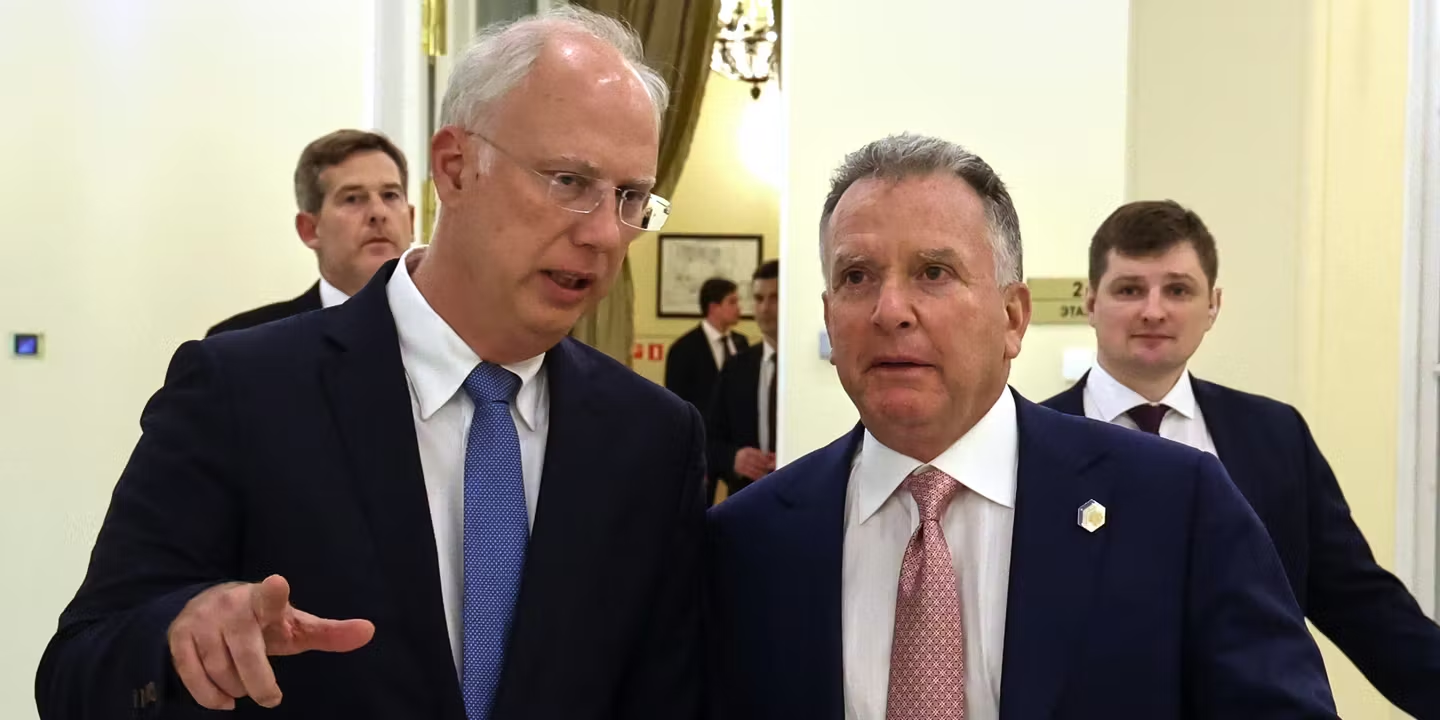
Bloomberg also produced a separate transcript of an October 29 exchange involving Kirill Dmitriev, a Kremlin economic emissary closely involved in outreach to American officials. Dmitriev told a Russian colleague, translated to English, “I think we will make this paper about our position, and I will make it circulate informally”, and he added, “I do not think they will take exactly our version but at least it will be as close as possible”. Those lines suggest a deliberate attempt to draft a text that Moscow could live with, while relying on informal circulation to influence Western interlocutors.
How the 28-point framework took shape
The reporting links the Witkoff-Oushakov and Dmitriev contacts to the emergence of a 28-point American plan that surfaced publicly in early November. U.S. and Ukrainian officials, including President Volodymyr Zelensky’s team, were reported to have worked on revisions to that initial draft. The U.S. pushed this revised text as a negotiating base, while Moscow signaled it could be used as a foundation for talks, though Russia had not discussed its text in detail with Washington, according to public statements.
Axios reported that Kirill Dmitriev spent three days in Miami with Steve Witkoff and other U.S. officials from October 24 to 26, a meeting that, combined with the October 14 call, helps explain how the language of the plan moved between capitals. Donald Trump later told reporters that Mr. Witkoff would travel to Moscow to meet President Putin, and he suggested that Jared Kushner might be involved, saying, “Steve Witkoff is going, maybe with Jared, I am not sure Jared will go, but he is involved in the process, he is a smart guy”.
Responses from Washington, Moscow, and Kyiv
The White House sought to minimize the political fallout, with communications director Steven Cheung telling AFP, translated to English, “This story proves one thing: Special Envoy Witkoff speaks to officials in both Russia and Ukraine almost every day to obtain peace, which is exactly what President Trump appointed him to do”. The administration framed Witkoff’s outreach as part of his mandate to seek an end to the fighting.
Russian officials did not immediately respond to Bloomberg’s requests for comment. Ukraine said it supported the U.S. framework in broad terms, while underscoring that sensitive territorial questions still needed to be resolved directly at the presidential level. President Zelensky’s team told Axios and other outlets that most points were agreed upon between teams, but that the key territorial concessions would require direct talks between Zelensky and Trump.
Political and security implications
Critics warned that the method of informal back-channeling and private advice to Moscow carried risks. Politico described Witkoff’s approach as sometimes leading to errors with Russia, and anonymous sources cited there questioned his inexperience. Observers argued that a plan shaped in part by the Kremlin’s preferences could amount to diplomacy that echoes Russian war aims, rather than firmly defending Ukrainian sovereignty.
At the same time, supporters and some European officials signaled cautious optimism that the momentum might produce a ceasefire and a framework for negotiations. President Trump told reporters that an agreement was near, and he cited heavy, recent battlefield losses in stark terms, saying, translated to English, “Twenty-five thousand soldiers are dead last month, Ukrainian and Russian, twenty-five thousand in one month”, a claim that highlights the urgent human cost driving diplomatic urgency, and that drew immediate attention across capitals.
European leaders voiced mixed reactions. France and other Western partners emphasized keeping pressure on Russia through sanctions, while at least one EU member, Hungary, publicly urged rapid progress toward a ceasefire and praised the U.S. plan as a potential opportunity. The tension between seeking a negotiated end to the war and maintaining sanctions pressure surfaced repeatedly in public statements, underscoring the diplomatic tightrope facing NATO and EU members.
What happens next
According to public timelines, Steve Witkoff was expected to travel to Moscow to meet President Putin, as part of a broader push to finalize the text. U.S. officials have signaled that if the parties can settle outstanding points, a meeting between President Zelensky and President Trump could follow, to finalize any agreement. At the same time, Western leaders are discussing strengthened security guarantees for Ukraine, and the fate of frozen Russian assets, both of which will be crucial levers in any final deal.
The revelations about the Steve Witkoff Russia peace plan process show how back channels, informal drafts, and personal diplomacy can shape high-stakes negotiations, and they underscore the political sensitivities when private envoys advise adversarial governments about how to present proposals to the U.S. president. As the process unfolds, the core questions remain whether a negotiated end can protect Ukraine’s territorial integrity, and whether the U.S. and its allies can maintain unified pressure while pursuing a politically viable settlement.
Reporting on the transcripts and meetings was led by Bloomberg, with additional reporting from Axios and other outlets, and the transcripts and quotes cited above were published in English translations in those reports.