Trump’s Signals to Zelensky and Europe: Accept This Plan or You’re on Your Own
A 28-point plan, reportedly hammered out by US and Russian envoys and presented to Ukraine this week, comes with a stark ultimatum and an implicit threat: sign up or risk being abandoned by the United States. US President Donald Trump has indicated a firm stance, stating that Ukrainian leader Volodymyr Zelensky would “have to like” the US plan, signaling a potential unwillingness to negotiate further.
Since then, Trump has sent mixed messages, suggesting the plan is not his final offer but adding that if Zelensky does not accept it, he could “continue to fight his little heart out.” This leaves Zelensky with a difficult choice, as he recognized in a somber national address on Friday. The plan is perceived by many in Kyiv as a forced decision between losing crucial US support and capitulating to Russian demands, many of which the 28 points appear to accommodate.
The Grave Consequences of Losing US Support
If Kyiv were to lose US support, the repercussions would be severe. The nation’s weapons supplies and access to vital intelligence would be jeopardized, exacerbating existing crises. These include a critical shortage of soldiers, ongoing financial strains, and a deepening lack of confidence among Ukrainians in a presidency already tainted by scandal. Above all, rejecting the proposal could signal an existential separation from the US, carrying massive strategic implications for Ukraine and its European backers. It would risk the US turning its back on the conflict entirely, reneging on its pledges of a security guarantee for Ukraine, and effectively telling not just Zelensky but the Europeans as well: “You’re on your own.”
The Shifting Landscape of Weapons and Intelligence
While the loss of US weapons would undoubtedly hurt Ukraine, its impact might not be as devastating as it would have been three years ago. This is partly due to the evolution of the conflict, where drones have become increasingly prominent, overshadowing the role of traditional weaponry like tanks and anti-tank missiles. Furthermore, the weapons pipeline from Europe has expanded significantly, now surpassing that from the US. From the war’s inception through June 2025, Europe has allocated at least $40 billion in military aid, $5 billion more than the US.
The absence of US weaponry would most critically affect Ukraine’s air defense systems, including its Patriot batteries and missiles. Zelensky has repeatedly appealed for more air defenses from the US, but Patriots are in short supply. Even if the US were to cut off its own supply of missiles and spare parts, it might still allow European and other allies to continue their support. Ukraine has also had a limited supply of highly effective US ATACM missiles.
The Trump administration has shown a greater willingness to sell US weapons through a European-financed fund known as the Prioritised Ukraine Requirements List (PURL), valued at approximately $90 billion. However, this support could be withdrawn if Kyiv rejects the proposed plan. On a positive note, Ukraine has developed a formidable domestic drone and missile industry, with Ukrainian officials stating that 90% of the drones they utilize are manufactured within the country, though scaling up production remains a challenge.
Intelligence Sharing: A Critical Vulnerability
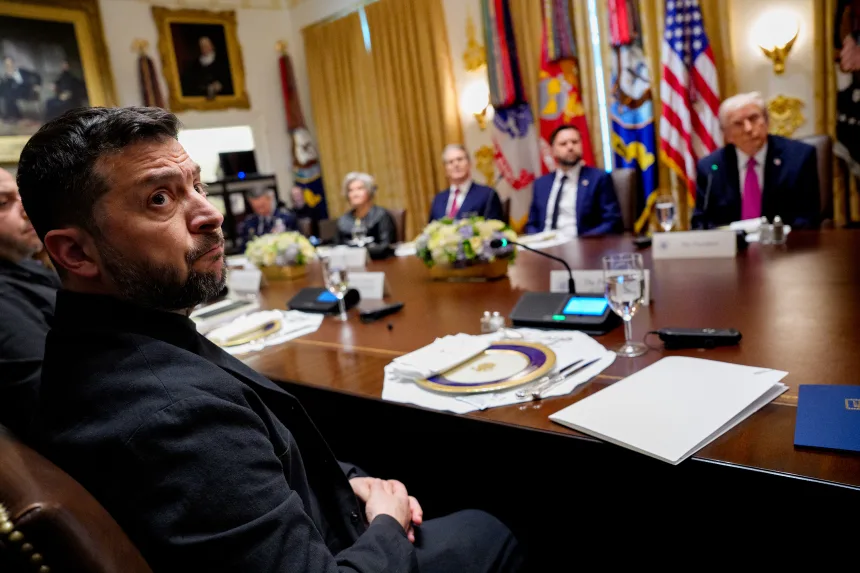
The US briefly halted intelligence sharing with Ukraine in March, following a controversial Oval Office meeting between Trump and Zelensky. The precise nature of this cooperation has never been publicly disclosed but likely includes early warnings of Russian missile launches and real-time analysis of Russian troop movements, which is critical as Russian forces make advances on several front lines. In October, Zelensky acknowledged that all of Ukraine’s missile defense systems – Patriot, NASAMS, and IRIS-T – would have limited data without US intelligence, severely hampering their defensive capabilities.
US intelligence has also been instrumental in enabling Ukrainian strikes deep inside Russia, targeting military and energy infrastructure, according to Ukrainian sources speaking to CNN. While European nations are improving their intelligence-gathering capabilities, building and coordinating such systems takes years. The potential loss of this intelligence sharing would leave Ukraine significantly more vulnerable.
Internal Challenges: Manpower and Financial Woes
Ukraine faces significant internal challenges that cannot be resolved by external military aid alone. The nation is grappling with a severe manpower crisis within its military, with tens of thousands of soldiers reported absent without leave in the first seven months of this year alone. Should Kyiv reject the US-Russian blueprint, US backing for its financial solvency could also be jeopardized. The International Monetary Fund estimates that Ukraine requires $65 billion in budget support over the next year alone. The European Union has struggled to reach an agreement on utilizing frozen Russian assets as a form of loan guarantee.
The 28-point plan, attributed to Trump’s envoy Steve Witkoff and Russian official Kirill Dmitriev, threatens to derail delicate negotiations regarding these frozen assets. One point reportedly states, “$100 billion in frozen Russian assets will be invested in US-led efforts to rebuild and invest in Ukraine. The US will receive 50% of the profits from this venture.” Furthermore, the plan insists that “Frozen European-held Russian funds will be unfrozen,” even if these funds are beyond US control and Europe is not a party to the plan.
Security Guarantees: Vague Promises and Existential Risks
Point 5 of the US-Russian plan states that “Ukraine will receive reliable security guarantees,” but offers no specific details. Language such as, “It is expected that Russia will not invade neighbouring countries” (point 3), is unlikely to inspire confidence in Kyiv. Some reports suggest an annex to the plan could stipulate that “a significant, deliberate, and sustained armed attack by the Russian Federation across the agreed armistice line into Ukrainian territory shall be regarded as an attack threatening the peace and security of the transatlantic community.” However, CNN has been unable to confirm the existence of such a clause.
Without precise and detailed guarantees, endorsed by the US Congress to have the force of law and backed by the threat of sanctions, it is difficult to see why Zelensky would agree to the vague outline presented in the plan. However, rejecting it carries an existential risk. For years, Russian President Vladimir Putin’s objective has been to divide Europe from the US. A recurring theme from the Kremlin since Trump took office has been to contrast Trump’s efforts to resolve the conflict with the “war-mongers” in Europe.
The 28-point plan appears to align with the current US administration’s somewhat detached view of NATO, an alliance that has been the cornerstone of European peace for 80 years. It proposes that “a dialogue will be held between Russia and NATO, mediated by the United States,” effectively shifting the US role from an ally to an arbitrator. European leaders, along with Japan and Canada, issued a statement on Saturday politely rejecting the plan, stating it “requires additional work.” They also expressed concern over “the proposed limitations on Ukraine’s armed forces,” which they believe would leave Ukraine vulnerable to attack.
European officials are scheduled to meet with their Ukrainian and US counterparts in Geneva on Sunday for more in-depth discussions on the blueprint. Some European observers view this as a pivotal moment. As former Lithuanian Foreign Minister Gabrielius Landsbergis stated on X on Saturday, “We have been told repeatedly and unambiguously that Ukraine’s security, and therefore Europe’s security, will be Europe’s responsibility. And now it is.”
A Watershed Moment for European Security
Just one month ago, Zelensky mentioned in a phone call with Trump that they had “discussed opportunities to bolster our air defense, as well as concrete agreements that we are working on to ensure this. There are good options and solid ideas on how to truly strengthen us.” The potential loss of weapons systems and intelligence, and their immediate impact on a battlefield that is steadily tilting in Moscow’s favor, as well as on Ukraine’s energy supplies, are significant concerns. However, these issues pale in comparison to the prospect that Washington might be prepared to reward Russian aggression, disregard its territorial seizures in Europe, and distance itself from what has been the most successful alliance for peace in modern history.
This sentiment was echoed by several senior Republicans on Saturday. US Senator Roger Wicker, chairman of the Armed Services Committee, remarked, “Any suggestion that we can pursue arms control with a serial killer and liar like Putin should be treated with great skepticism.” Anne Applebaum, writing in The Atlantic, noted, “There is a long tradition of great powers in Europe making deals over the heads of smaller countries, leading to terrible suffering.” She drew parallels to historical agreements, stating, “The Molotov-Ribbentrop pact with its secret protocols, brought us World War II. The Yalta agreement gave us the Cold War. The Witkoff-Dmitriev pact, if it holds, will fit right into that tradition.”