A clear, concise account of The Battle of Mogadishu, the mission that became an overnight fight, the tactical collapse, and the policy legacy
In the shattered corridors of Mogadishu, where concrete met dust and the sky hung low with smoke, a mission meant to last one hour stretched into an overnight struggle for survival. The Battle of Mogadishu—October 3 and 4, 1993—remains one of the most studied urban combat incidents in modern military history. That sentence captures why scholars, military planners, and the public still return to this fight, because it exposes how well-trained forces can be overwhelmed by politics, terrain, and numbers.
From humanitarian relief to a high‑risk capture mission
By late 1992, Somalia had collapsed into clan warfare, famine, and the destruction of state institutions. The United Nations authorized Operation Restore Hope as a humanitarian effort to restore order and allow food distribution. Initially, famine receded and UN forces secured key areas, but the mission soon shifted. Instead of staying neutral, international forces began targeting Mohamed Farrah Aidid and his Habr Gidr militia, after a series of attacks that included the killing of 24 Pakistani peacekeepers in June 1993.
That escalation led the United States to authorize Task Force Ranger, a detachment of elite operators formed to capture Aidid’s leadership. Task Force Ranger brought together Delta Force operators, U.S. Army Rangers, the 160th Special Operations Aviation Regiment, Air Force Combat Controllers, and supporting elements. The operation planned for October 3, 1993, was narrow, precise, and based on confidence in speed and surprise.
Precision, then calamity
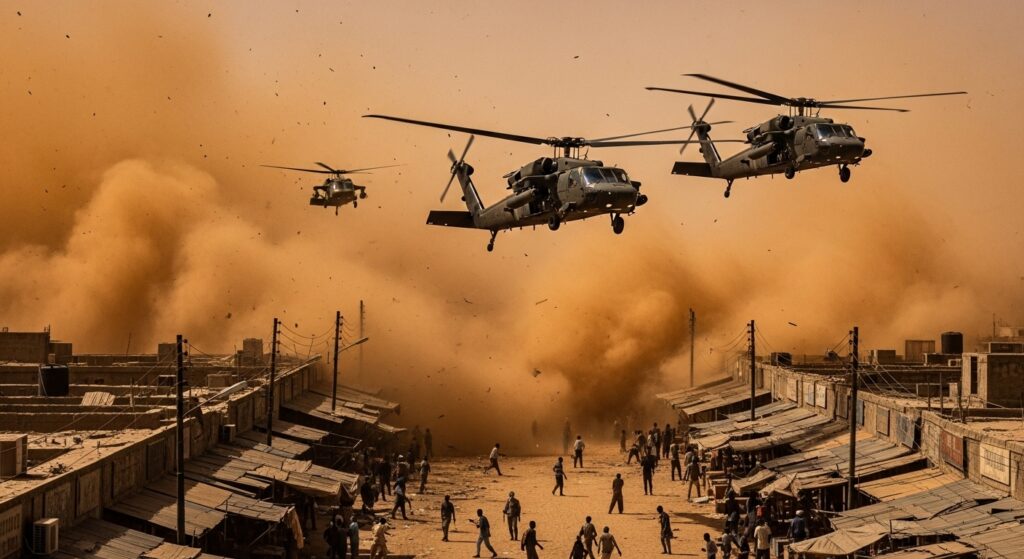
The October 3 raid began with textbook execution. Helicopters deployed Rangers and Delta operators to a building near the Bakara Market, and within minutes the objective was secured and high‑value detainees were in custody. Then the mission changed instantly. An RPG struck Super Six One, a Black Hawk piloted by Chief Warrant Officer Cliff “Elvis” Wolcott, and the helicopter spiraled into a narrow street. Moments later, another RPG downed Super Six Four, piloted by Mike Durant. With those two crashes, the operation morphed from a rapid capture raid into a desperate rescue under fire.
The initial crash sites became islands of American soldiers surrounded by a city that knew every alley and rooftop. Urban terrain neutralized many technological advantages. Lightweight Humvees, restricted by political decisions, could not provide the armored protection needed when insurgent fighters used RPGs and positioning in buildings to deadly effect. Communications frayed as smoke and dust filled the air, and a planned extraction convoy became lost in narrow streets blocked by barricades and hostile crowds.
The fight for the first crash site and the second rescue
The first crash site turned into one of the most intense small‑unit engagements in recent U.S. history. Rangers and Delta operators established a defensive perimeter while medics worked under non‑stop fire. Ammunition dwindled, casualties mounted, and the night closed in. Thousands of militia and armed civilians converged, using AK‑47s, RPGs, and technicals to press the attack. Despite local tactical success in short fights, the Americans were overwhelmed by numbers and proximity.
The second crash produced acts of extraordinary heroism. Two Delta Force snipers, Master Sergeant Gary Gordon and Sergeant First Class Randy Shughart, repeatedly volunteered to protect pilot Mike Durant. Inserted into an exposed position, they fought until they were overrun, actions later recognized with the Medal of Honor. Durant was captured and later released after negotiations, a rare instance of a downed aircrew surviving long captivity during such a chaotic battle.
Rescue, retreat, and political consequences
As night fell, forces pinned at the first crash site were low on food, water, and medical supplies. Helicopters flew dangerously low to provide suppressive fire and to drop limited supplies, while relief forces organized from disparate elements, including Malaysian armored personnel carriers and Pakistani tanks escorted by American troops. The relief convoy fought through to reach the survivors in the early morning, and many Rangers had to run behind armored vehicles under fire, in a movement later called the Mogadishu Mile.
When the smoke cleared, the costs were stark and immediate. Eighteen Americans were killed and more than 70 wounded. The United States achieved some tactical objectives, but politically and strategically the result was viewed as a reversal. President Clinton ordered a drawdown of forces and a halt to offensive operations, and Aidid remained at large. The images of American casualties dragged through Mogadishu streets influenced U.S. policy debates and public sentiment, contributing to a longer term reluctance to commit ground forces to similar humanitarian interventions.
Lessons, doctrine, and legacy
The Battle of Mogadishu left enduring lessons that reshaped military thinking on urban combat and interagency planning. Analysts emphasize that urban warfare erodes technological advantages, close quarters diminish the value of air superiority and night‑vision gear, and local social dynamics can mobilize large numbers of fighters in minutes. Commanders also learned the hard truth that special operations units, no matter how capable, cannot substitute for clear political objectives, appropriate force protection, and alignment between military tactics and diplomatic constraints.
Those lessons influenced later U.S. campaigns in Afghanistan and Iraq, and they fed doctrine on counterinsurgency, urban operations, and joint force integration. Veterans of Mogadishu also point to another legacy, the demonstration of extraordinary courage and unit cohesion, shown in actions like those of Gary Gordon and Randy Shughart, and in the persistence of Task Force Ranger under overwhelming pressure.
The Battle of Mogadishu, on October 3 and 4, 1993, remains a case study because it exposes how missions evolve, how assumptions can collapse, and how combat in dense cities punishes misaligned strategy. The story is not only about failure or triumph, it is about the intersection of politics, terrain, and human bravery, and about the long shadow a single, brutal night can cast over national policy and military practice.
Key cited details from sources: the killing of 24 Pakistani peacekeepers in June 1993, the names Chief Warrant Officer Cliff “Elvis” Wolcott, Mike Durant, Master Sergeant Gary Gordon, and Sergeant First Class Randy Shughart, and the sentence, The Battle of Mogadishu—October 3 and 4, 1993—remains one of the most studied urban combat incidents in modern military history. These facts and phrases appear in official after‑action reports and contemporary analyses that shaped the account above.