Why Prisoners of Geography matters now, and how maps make sense of power
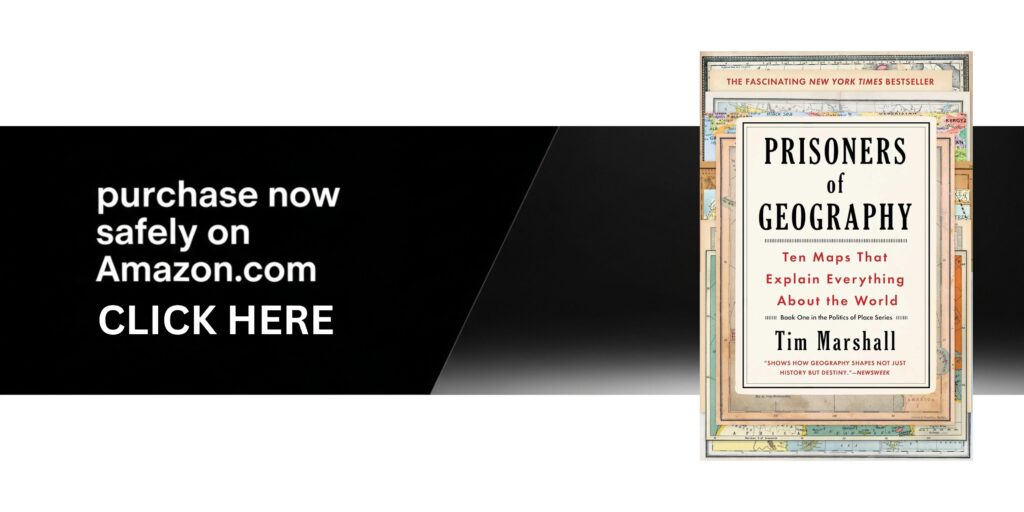
“There are books that attempt to explain the world, and there are books that expose it,” and Tim Marshall’s Prisoners of Geography: Ten Maps That Explain Everything About the World is very much the latter. The book strips away political rhetoric and diplomatic theater to reveal a simpler force that quietly shapes global strategy, national aims, and recurring conflict, the fixed features of the planet itself.
Marshall argues that leaders and states are often less driven by ideology or destiny, and more by the ground beneath their feet. That premise, that geography constrains ambition and maps predict behavior, helps readers make sense of headlines about Russia, China, the United States, and emerging theaters like the Arctic.
Russia, depth and the logic of buffer zones
Marshall opens with Russia, a case many reviewers single out. The book explains Moscow’s historical paranoia with calm clarity, showing how flat plains and open routes made invasion a recurring nightmare. Because Napoleon and Hitler, among others, were able to push into Russian territory, leaders in Moscow have long sought strategic depth, warm-water ports, and friendly buffer states.
This focus on terrain does not excuse aggression, it explains choices. When readers apply the Prisoners of Geography lens to contemporary events, Russian moves feel less irrational and more predictable. Geography, in Marshall’s account, forces policymakers to think in centuries and in space, not only in ideology.
China, mountains, seas, and the Belt and Road reframed
Another chapter that reviewers frequently praise is on China. The book treats the Himalayas as a natural fortress, the Gobi Desert as both barrier and shield, and the South China Sea as a trade highway Beijing must control if it wants to reduce maritime vulnerability. Marshall frames the Belt and Road Initiative not simply as diplomacy, but as a geographic strategy, a way for China to build continental escape routes and economic depth.
Seen through the Prisoners of Geography view, China’s island building, port investments, and continental rail links are understandable as attempts to change Beijing’s strategic map, while still constrained by mountains, rivers, and seas.
Africa and Latin America, abundance and fragmentation
Marshall’s chapters on Africa and Latin America underline a repeated insight from reviews, the difference between natural wealth and geopolitical weight. Africa’s riches have not produced unified continental power because fragmented rivers, few natural harbors, and vast plateaus make integration and defense hard. Marshall shows how the lack of navigable waterways and cohesive, defensible borders limited continental state-building, even with abundant resources.
Latin America, similarly, is a region of abundance without integration. The Andes form a spine that divides populations, and the Amazon isolates rather than links cities. That physical fragmentation helps explain why large nations like Brazil can inspire ambition, but remain constrained in global reach.
The Middle East, Europe, the United States, and the Arctic
The Middle East chapter reads like a guided walk through fault lines. Marshall points to ancient trade routes, oil lanes, and colonial borders drawn with a ruler, to show how narrow corridors and artificial lines produce cycles of conflict. Reviewers often say the region is not chaotic by nature, it is chaotic by design, shaped by geography that invites rivalry.
Europe, described as a geopolitical jigsaw, remains fragmented by mountains, peninsulas, and rivers that direct rivalry more than unity. In his account, the European Union operates against a physical backdrop that favors division, not easy consolidation.
By contrast, the United States benefits from a rare geographic advantage, fertile plains, deep rivers, two oceans, and largely friendly neighbors. Marshall avoids triumphalism, but he stresses that American power is grounded in geography as much as policy.
Finally, one of the most forward-looking parts of the book focuses on the Arctic. As ice melts, new trade routes and resources open, drawing attention from Russia, Canada, the U.S., and Europe. Reviewers praised this as a chapter that anticipates future contests over sea lanes and minerals.
What critics praise and what they warn about
Across reviews, readers commend Marshall’s ability to make geopolitics accessible without oversimplifying. The book gives a practical framework for reading headlines, turning chaotic events into pieces of a geographic puzzle. Reviewers also note Marshall’s balanced tone. He rarely moralizes, instead describing nations as actors shaped by terrain.
Still, critics warn of limits. A single chapter cannot capture a region’s full complexity, and geography is not the whole story. Technology, culture, institutions, and ideology also change outcomes. Some reviewers say the book repeats its central point at times, but most agree that the clarity it brings outweighs those limits.
Marshall drives his point home with memorable lines. He writes, “To understand power, you must first understand the ground beneath it,” a conclusion that many reviewers found haunting and hard to forget. That phrase captures the book’s core lesson, that human ambition often collides with mountains, rivers, and frozen coasts, and loses.
Readers who take the Prisoners of Geography frame away from the book gain a durable tool. News that once felt random begins to align with map features, whether it is Russia’s moves in Ukraine, China’s island-building in the South China Sea, or investment flows tied to the Belt and Road. Geography does not determine destiny, but it shapes options, paths, and pressures.
The enduring value of Prisoners of Geography lies in that reframing, its ability to show readers how a mountain range, a strait, or a river valley can influence policy for decades. For anyone trying to understand why states act the way they do, Marshall’s maps offer a clearer, if sobering, perspective.
“Prisoners of Geography: Ten Maps That Explain Everything About the World” will not answer every question about culture, technology, or institutions, but it does offer a lens that helps explain why nations often march in the directions the map makes easy, and why the ground beneath their feet still matters immensely.