A clear-eyed look at the Surgical Intervention in Iran and Its Geopolitical Aftershocks, from precision munitions to domestic politics and the hard diplomacy ahead
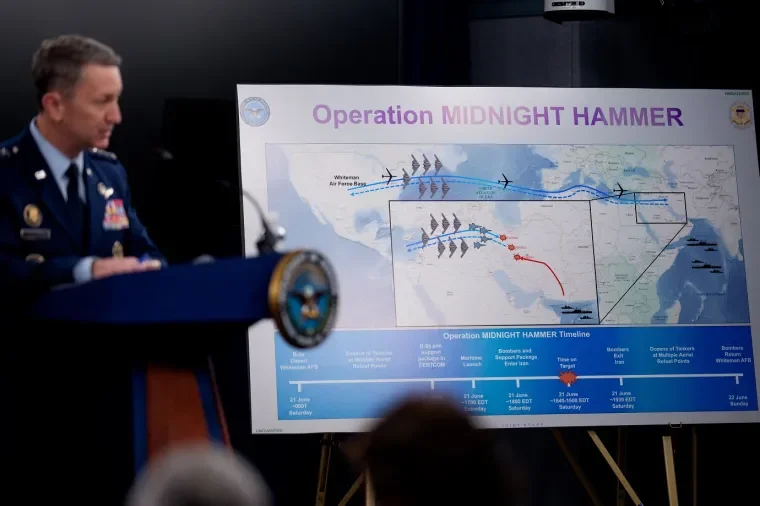
In late June 2025 the United States carried out a short, highly publicized series of strikes that U.S. officials described as “surgical”, hitting nuclear and military facilities long tied to Iran’s weapons program. The operation marked a clear shift from covert pressure and diplomacy to overt, kinetic action, and it quickly produced ripples across the Middle East, in Washington, and inside Tehran.
The strikes, which targeted sites widely associated with Iran’s nuclear program, were notable for both what they hit and how they were framed. As one account put it, “The strikes, announced by the White House as direct U.S. military action in tandem with an intensive Israeli campaign, targeted facilities long associated with Iran’s nuclear program (notably Fordow, Natanz and Isfahan), and marked a dramatic moment when Washington moved from diplomatic pressure and clandestine operations to overt kinetic participation,” (Wikipedia). Those facilities were central to international concerns about a possible Iranian nuclear breakout, and their damage represented a tangible, if temporary, slowing of Tehran’s progress.
Why Washington chose a surgical route, and why then
The decision to support and join a campaign described as Surgical Intervention in Iran and Its Geopolitical Aftershocks reflected a convergence of strategic logics. U.S. officials and analysts argued that a nuclear-capable Iran would destabilize the region and threaten partners, including Israel. The timing was driven in part by Israeli action, which itself was premised on a narrowing window to prevent Iran from consolidating a more survivable nuclear capability. As one analyst summary noted, “Israel launched its large-scale strikes on June 13, and the situation rapidly escalated into a regional crisis,” (rand.org). Faced with that sequence, U.S. leaders judged that intervention would both reassure an ally and blunt capabilities that Israel alone might not fully eliminate.
Operationally, the United States highlighted modern precision weapons and delivery methods. Officials emphasized the use of “stand-off munitions, stealth delivery platforms, and careful targeting intended to minimize American casualties and civilian collateral damage,” (The White House). The public framing underscored an intent to avoid a ground occupation, and to portray the intervention as narrowly tailored, while still signaling resolve. That combination of precision and public messaging defined the U.S. contribution to the campaign.
Precision strikes, escalation risk
Calling an operation surgical does not erase its strategic consequences. The very success of precision attacks can sharpen risks of asymmetric retaliation. Tehran publicly vowed reprisals, with one summary noting “Tehran’s public vows of ‘unavoidable’ reprisal and the subsequent missile and drone exchanges underscored that tactical success does not equal strategic closure; the strikes reset, rather than resolved, the underlying contest,” (The Guardian). In the weeks after the strikes, analysts warned that cyberattacks, proxy strikes, attacks on shipping lanes, and covert operations would remain likely avenues of Iranian response.
The strikes also altered deterrence perceptions across the region. By demonstrating the ability to reach hardened, deeply buried sites without large forward force deployments, the U.S. and its partners recalibrated Tehran’s sense of sanctuary. That change complicated the calculus of Iranian proxies, who suddenly faced limits on Tehran’s ability to shield critical infrastructure. Yet that same demonstration raised the stakes of miscalculation, since Iran and its allies could choose asymmetric options with lower thresholds for deniability and escalation.
Domestic politics, legal questions, and alliance management
The intervention exposed strains in U.S. domestic politics, as legal and constitutional questions surfaced about presidential war powers and congressional notification. Critics argued that even a narrowly targeted bombing campaign carries strategic consequences that require legislative buy-in. As one report framed it, “constitutional politics at home, questions about presidential war powers and whether congressional approval had been sought sufficiently in advance, exposed a rift that could complicate future U.S. decision-making,” (Politico). Supporters countered that speed and secrecy can be necessary to blunt imminent threats, but the debate matters because domestic unity is essential to sustain any long-term coercive campaign.
At the alliance level, the U.S. move signaled a re-entrenchment of American security guarantees in the region. Some partners welcomed the show of force, while others feared deeper entanglement. Gulf states and European capitals called publicly for restraint, even as many supported non-proliferation goals. How Washington uses its diplomatic capital in the weeks and months after the strikes will determine whether the action becomes a path to stabilization, or a persistent source of friction.
Limits of military options, and the diplomatic test ahead
Military success can buy time, but it rarely solves the political drivers of nuclear ambitions. Destruction of facilities delays weapon timelines, but it does not automatically change a state’s calculus of insecurity, regional rivalry, or domestic legitimacy. Observers cautioned that kinetic effects must be paired with an urgent diplomatic architecture offering a credible off-ramp, otherwise Tehran may shift to dispersed, covert programs that are harder to monitor and contain. As one analysis warned, “If Washington’s strikes are not followed by a credible diplomatic architecture offering a security-oriented bargain, Tehran may recommit to covert or dispersed programs — increasing the difficulty of long-term verification and restraint,” (Carnegie para a Paz Mundial).
The final assessment of the U.S. role in the operation depends less on ordnance than on follow-through. As another summation put it, “If the strikes produce a durable diplomatic pathway that reduces regional insecurity, they may be judged a rare instance where force created space for politics. If they produce a prolonged cycle of asymmetric retaliation and domestic political fragmentation in Washington, they may instead be remembered as an escalation whose costs exceeded its reach,” (Carnegie para a Paz Mundial).
The phrase Surgical Intervention in Iran and Its Geopolitical Aftershocks captures both the precision of the strikes and the uncertainty of their consequences. The immediate military effects are tangible, including delays to Iran’s nuclear timelines, and a reshaped regional deterrence narrative. The long term will hinge on diplomacy, coalition management, and whether the United States and its partners can convert a tactical success into a strategic solution that reduces the incentives for future nuclearization and asymmetric retaliation.
For now, capitals from Riyadh to Brussels are watching how Washington manages escalation, protects civilians and forces, and pushes for a diplomatic off-ramp. The coming months will determine whether this intervention becomes a rare instance where force created space for politics, or the start of a prolonged cycle of tit-for-tat actions that further destabilize an already volatile region.