Revisiting Huntington’s Clash of Civilizations in 2025, why cultural identity now drives U.S., China, Russia, and Middle East conflicts
In 1996, Samuel P. Huntington published The Clash of Civilizations and the Remaking of World Order was published in 1996, and he argued that the main sources of global conflict would shift from ideology and economics to deep cultural identities. That insight, once controversial, now reads to many like a map of our present moment.
Huntington famously wrote, “The great divisions among humankind and the dominating source of conflict will be cultural. Nation states will remain the most powerful actors, but the principal conflicts of global politics will occur between nations and groups of different civilizations.” His phrasing still frames how analysts interpret clashes across borders, technologies, and societies in 2025.
A map drawn in faith and fault lines
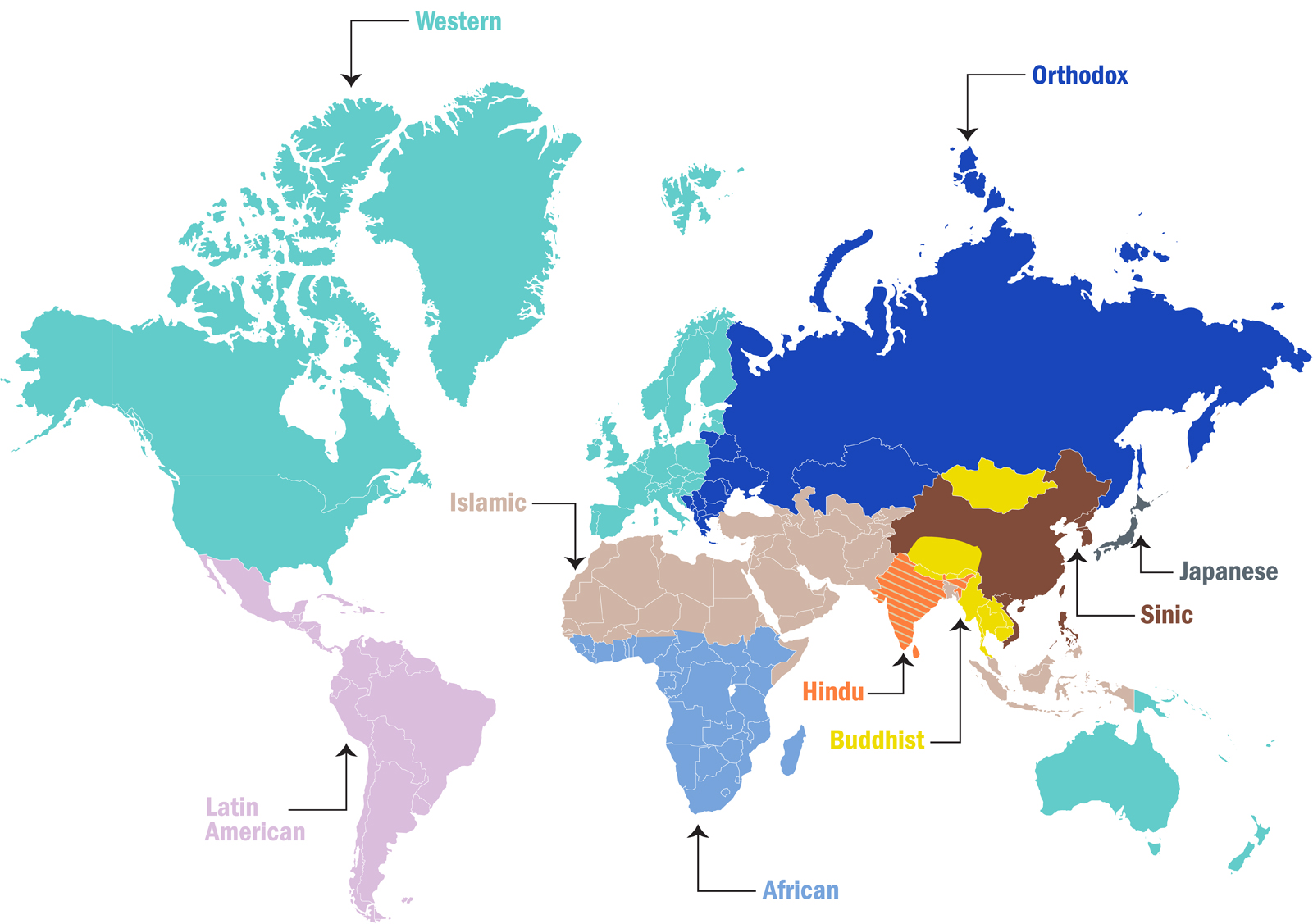
Huntington divided the world into civilizational blocs, including the Western, Islamic, Sinic, Hindu, and Orthodox spheres, among others. He argued that these civilizational identities, rooted in religion, language, and history, would define the major fault lines of global politics.
Today, those fault lines are visible in several arenas. The U.S.–China competition is not only economic or technological, it is also shaped by competing visions of governance and social order. The Russia–West standoff is framed by renewed assertions of Orthodox and Russian civilizational identity, and the Middle East remains a region where religious, historical, and political identities continually reshape alliances and conflict.
From thesis to the headlines
Huntington did not claim his framework would predict every event. Instead, he offered a lens that highlights the role of culture and identity beneath policy and power. That lens helps explain why confrontations often resist purely material explanations.
Consider how technology competition now serves as a proxy for civilizational influence. From standards for artificial intelligence, to control over data flows, states are fighting over which model will set rules for the future. These battles have economic stakes, but they are also contests over values, trust, and social models.
Across Europe and North America, internal cultural battles show another side of the theory. Huntington anticipated that clashes would occur within civilizations as well as between them. He warned that if societies ignored cultural difference, they risked deeper conflict. In his words, “If we do not recognize the reality of cultural difference,” he implied, “we will stumble blindly into wars of ignorance.” Those internal debates about identity, migration, and national purpose are now central to politics in many Western countries.
The clash within, not just between
One of the most important, and often overlooked, points in Huntington’s work is that civilizational fault lines run inside states as much as across their borders. National politics in the United States, across Europe, and in other Western societies reflects tensions between cosmopolitan, liberal elites and voters who seek stronger cultural anchors.
Similarly, the Islamic world has experienced both fragmentation and reassertion of identity. Some countries push toward modernizing reforms, while others double down on traditional religious frameworks. These internal dynamics reverberate overseas, influencing migration, diplomacy, and regional security.
This internal dimension helps explain why seemingly domestic disputes—over history, education, and public rituals—can have outsized geopolitical consequences, shaping alliances and stoking external tensions.
Why Huntington still matters in 2025
Nearly three decades after his book, Huntington’s framework remains relevant because it forces policymakers to look beyond immediate interests and consider enduring cultural forces. It does not provide simple answers, but it helps interpret patterns that other theories miss.
Reading contemporary crises through the lens of the Clash of Civilizations clarifies why some conflicts are so resistant to conventional diplomacy. When disputes touch on identity, they demand strategies that combine hard power with cultural literacy.
Huntington’s approach also cautions against assuming cultural convergence. Globalization makes contact inevitable, but contact does not mean assimilation. As civilizations meet, the contrasts often sharpen, not soften.
For diplomats and analysts seeking to reduce friction, the implication is clear: policies that ignore cultural contexts risk unintended consequences. Understanding the claims people and states make about their histories, beliefs, and futures is now part of effective statecraft.
The phrase “The great divisions among humankind and the dominating source of conflict will be cultural” remains a provocative reminder that power is not only material. It is also moral and symbolic. As governments compete over narratives, institutions, and the rules of the digital age, civilizational frames will continue to shape which coalitions form and which disputes escalate.
Whether one agrees with all of Huntington’s conclusions, his work has reshaped how practitioners and scholars ask questions about the world. In 2025, the book functions less as a prediction and more as a diagnostic tool, helping readers see the cultural currents that run beneath the daily headlines.
As global institutions confront renewed contestation, recognizing the role of civilization, culture, and identity will be essential for anyone trying to understand why some conflicts endure, and how peace might be pursued in an age of competing worldviews.